Enterprise Rank Tracking: The UK Guide to Local SEO at Scale
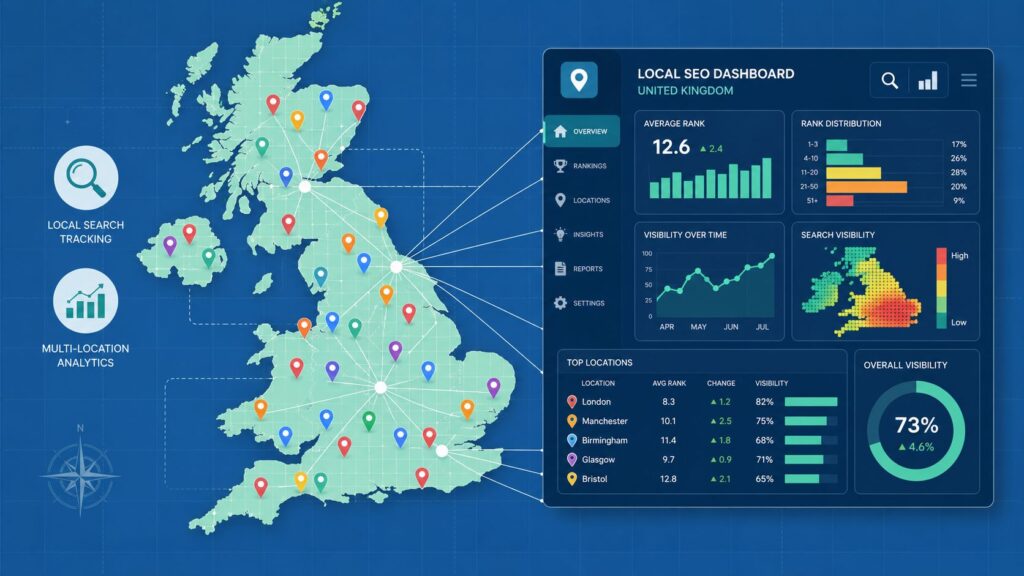
56,710 UK businesses employ 250 or more people, yet that group makes up only 1% of all UK enterprises while accounting for 48% of total employment and 58% of business turnover according to the Office for National Statistics. That single fact changes how rank tracking should be discussed.
For a national franchise director, search visibility isn't a neat line on a monthly SEO report. It's whether a branch in Croydon disappears from the local pack while Bromley holds steady. It's whether a regional manager can prove that stronger map visibility led to more calls, direction requests and in-store demand. At enterprise scale, rank tracking stops being a keyword log and becomes an operating system for local revenue protection.
Teams frequently don't struggle because they lack data. They struggle because they're looking at the wrong resolution. National averages smooth over the very locations where performance breaks.
What Is Enterprise Rank Tracking
Enterprise rank tracking is the process of monitoring search visibility across a large footprint of locations, service areas, franchises or business units, then turning that data into local action. It isn't the same as checking whether one website ranks for a shortlist of phrases.
In the UK, the need is obvious. The enterprise end of the market is concentrated in a relatively small number of organisations with outsized economic weight, and those organisations often manage hundreds or thousands of customer touchpoints. The ONS figures above explain why local visibility failures can carry serious commercial consequences for major brands, especially where a business depends on branch visits, booked appointments or route-based discovery.
A standard rank tracker answers a narrow question. “Where do we rank for this keyword?”
An enterprise setup answers harder questions:
- Which regions are losing visibility: Are franchisees in the North West slipping while London remains stable?
- Which search surfaces are changing: Is the map pack weakening while organic web results hold?
- Which locations need intervention first: Which branches require profile, category, content or review work now?
- Which losses affect revenue most: Which drops are tied to calls, footfall and regional trading performance?
That's why I'd treat rank tracking as part reporting layer, part alerting system, part market intelligence. If you're reviewing broader thinking on enterprise keyword tracking in 2026, the useful takeaway is that scale changes the job itself. More keywords don't just mean more rows in a spreadsheet. They require different segmentation, different governance and a different standard of accuracy.
A proper local setup also has to reflect how people search. A borough-level weakness in London can matter more than a healthy national average. That's the gap organizations often discover once they move beyond a basic report and into a complete guide to local rank tracking.
Enterprise rank tracking matters when one brand can be winning nationally and still losing locally in the places that generate the most demand.
The Leap from Standard to Enterprise Tracking
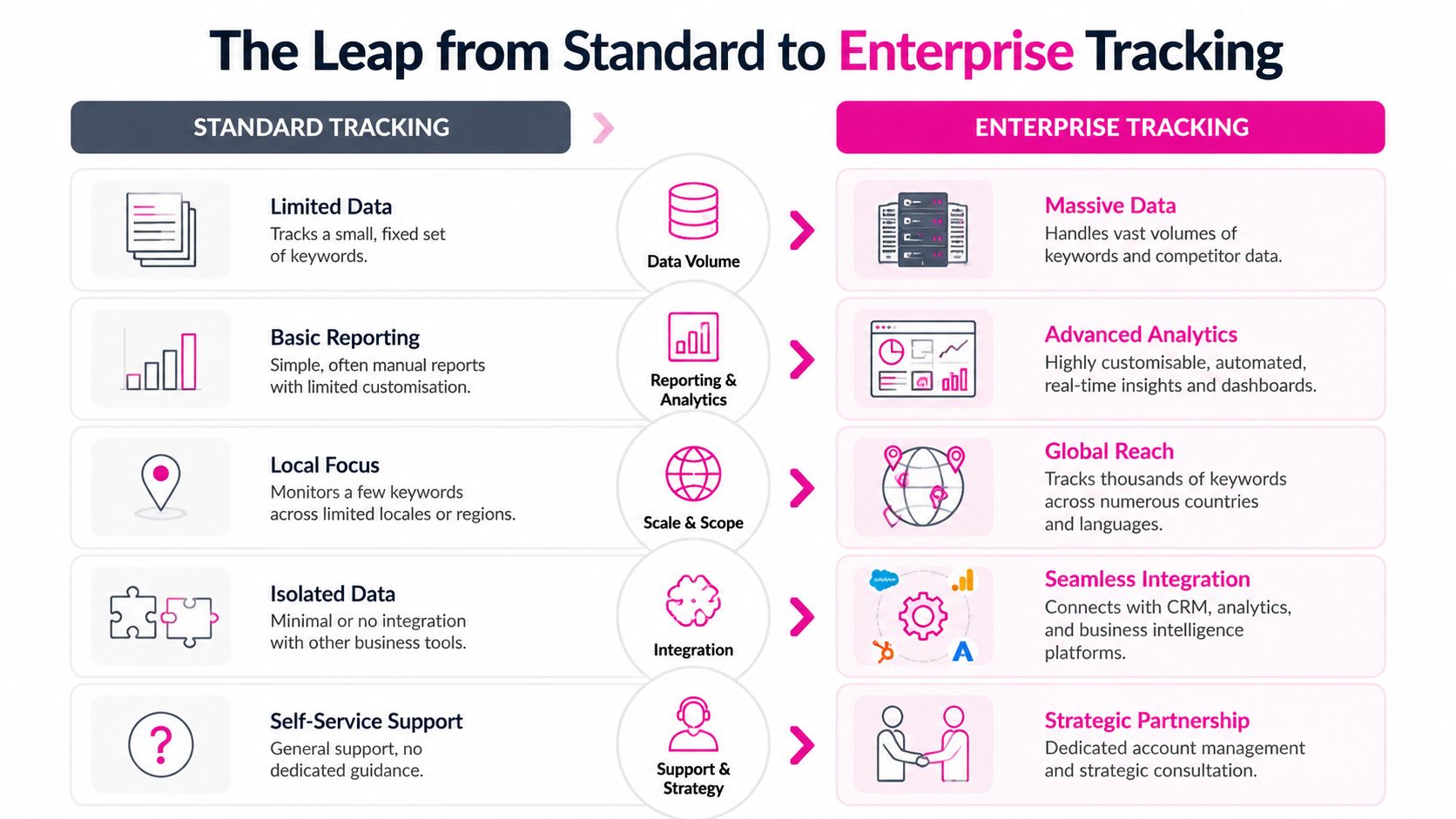
Most SEO platforms say they track rankings. That's technically true, but it hides the difference between a tool built for one site and one built for a distributed business.
Scale changes the job
A single-location business can often work with a compact keyword set and a limited reporting cycle. A national franchise can't. It needs tracking by location, service line, region, device and competitor set.
That's where smaller systems usually fail. They treat every query as if it behaves the same way across the country. It doesn't. In UK enterprise SEO, visibility needs to be resolved at city or ZIP-code granularity because Google's local pack and AI Overviews can shift by 3 to 7 ranking places within a 10km radius for high-intent service keywords, as outlined in this enterprise rank tracker buyer's guide.
If you're managing branches across Greater London, that means one clinic or showroom can look healthy in a city-wide report while underperforming badly in the actual districts that matter.
Granularity beats averages
The core leap is granularity. Standard tracking tends to report at campaign level. Enterprise tracking has to report at market level.
A national dashboard might tell you the brand ranks well for “solicitor near me” or “hotel in city centre”. That sounds reassuring until one cluster of postcodes goes soft and local competitors start taking share.
Enterprise teams need data broken down by:
| Tracking level | What it reveals | Why it matters |
|---|---|---|
| Country | Broad trend direction | Useful for executive summaries, weak for operations |
| Region | Performance by franchise territory or business unit | Helps allocate local budget and support |
| City or borough | True local pack competition | Exposes market-specific weaknesses |
| Postcode or geo-grid | Street-level variation in visibility | Shows where demand capture is actually leaking |
Many roll-outs falter. Teams buy a bigger platform but keep reporting like an SMB. Same monthly deck, same national averages, same vague actions.
Frequency affects usefulness
Rank data has a shelf life. In local search, it expires quickly.
Enterprise platforms need daily or on-demand crawl frequency for UK geo-grids because local volatility moves too fast for weekly snapshots in many categories, especially in competitive urban markets. If a tool only refreshes on a weekly basis, the operational team often sees the issue after the commercial impact has already landed.
Practical rule: If a location depends on urgent intent, such as hospitality, home services, legal or healthcare, slow rank tracking isn't just inconvenient. It creates blind spots.
Standard tools still have a place
This doesn't mean standard tracking is useless. It still works for:
- Compact campaigns: A small location set with limited local variation
- Editorial SEO: National content programmes where local pack visibility isn't the main driver
- Basic monitoring: Lightweight trend spotting before a larger rollout
But once a business has multiple territories, multiple stakeholders and multiple local competitors, “good enough” tracking usually becomes misleading tracking.
Must-Have Enterprise Rank Tracking Features
A real enterprise platform shouldn't win on feature count. It should win on whether the data can support local decisions that people inside the business will trust.
Geo-grid tracking that reflects how UK markets work
The first essential is advanced geo-grid tracking. Not generic city-level pins. Not “UK rankings” as a proxy for local performance.
For UK postcodes, geo-grid rank tracking should use three distinct grid types: City Centre Grid, District Grid and Postcode Grid, as explained in this guidance on rank tracking for local keywords. Each one serves a different purpose.
- City Centre Grid: Best for dense urban cores where competition is compressed and local pack positions can change quickly.
- District Grid: Useful for tracking neighbourhood shifts across larger towns and cities.
- Postcode Grid: Necessary when branches serve tightly defined local catchments.
A good implementation also respects device behaviour. In high-traffic UK zones, mobile rank checks benefit from daily updates while desktop scans can run weekly. That split is practical. It keeps data fresh where mobile volatility is highest without creating pointless noise everywhere else.
Heatmaps that expose weak coverage
Enterprise teams need visual output, not just exports. Heatmaps are one of the few reporting formats that senior operators, franchise managers and SEO leads can all understand quickly.
A strong heatmap should let you see:
- Coverage holes: Where visibility drops away by district or postcode
- Pattern shifts: Whether a decline is isolated or spreading across an area
- Competitor pressure: Which local rival is replacing you in weak zones
- Device differences: Where mobile and desktop diverge in a way that changes action
That matters because the response is rarely generic. One weak area might need Google Business Profile category work. Another might need location page refinement. Another might need a review acquisition push.
Segmentation by region and business unit
Enterprise rank tracking without segmentation becomes political very quickly. National directors want roll-up reporting. Regional teams want their own view. Franchisees want to know their branch isn't being judged against the wrong comparator set.
A credible platform has to segment by geography and ownership model. That means you should be able to break out reporting by:
| Segment | Why it matters |
|---|---|
| Region | Reflects different SERP conditions and local competition |
| Franchise group | Supports fair performance comparisons |
| Service line | Prevents blended reports that hide underperforming categories |
| Device | Separates mobile-first local intent from desktop behaviour |
If a vendor can't handle this cleanly, the reporting layer will become a workaround exercise.
The best enterprise setups let head office see the whole estate while letting local teams act on their own patch.
Separate tracking for organic and local pack
This is another buyer trap. Some tools collapse local and organic visibility into one line. That sounds simpler, but it leads teams to fix the wrong problem.
You need separate monitoring for standard web results and local pack presence. If map visibility falls while organic pages remain stable, the remedy may sit inside profile optimisation, category alignment, reviews or proximity-sensitive signals rather than on-page SEO.
A serious local SEO ranking tracker should make those distinctions obvious.
Reporting that plugs into the business
Enterprise rank tracking also needs to leave the SEO team. If the only output is a PDF for marketing, the system is underused.
Look for reporting that can support:
- Executive summaries: Clear enough for finance and operations
- Regional scorecards: Practical enough for territory managers
- Alerting workflows: Useful enough for day-to-day response
- Data export or integration: Flexible enough for BI and analytics environments
The deciding question isn't “does it have dashboards?” Most do. The actual question is whether those dashboards help someone decide where to act next.
How to Measure Rank Tracking ROI
Rank tracking doesn't pay for itself because positions moved. It pays for itself when better visibility leads to more demand capture in the right places.
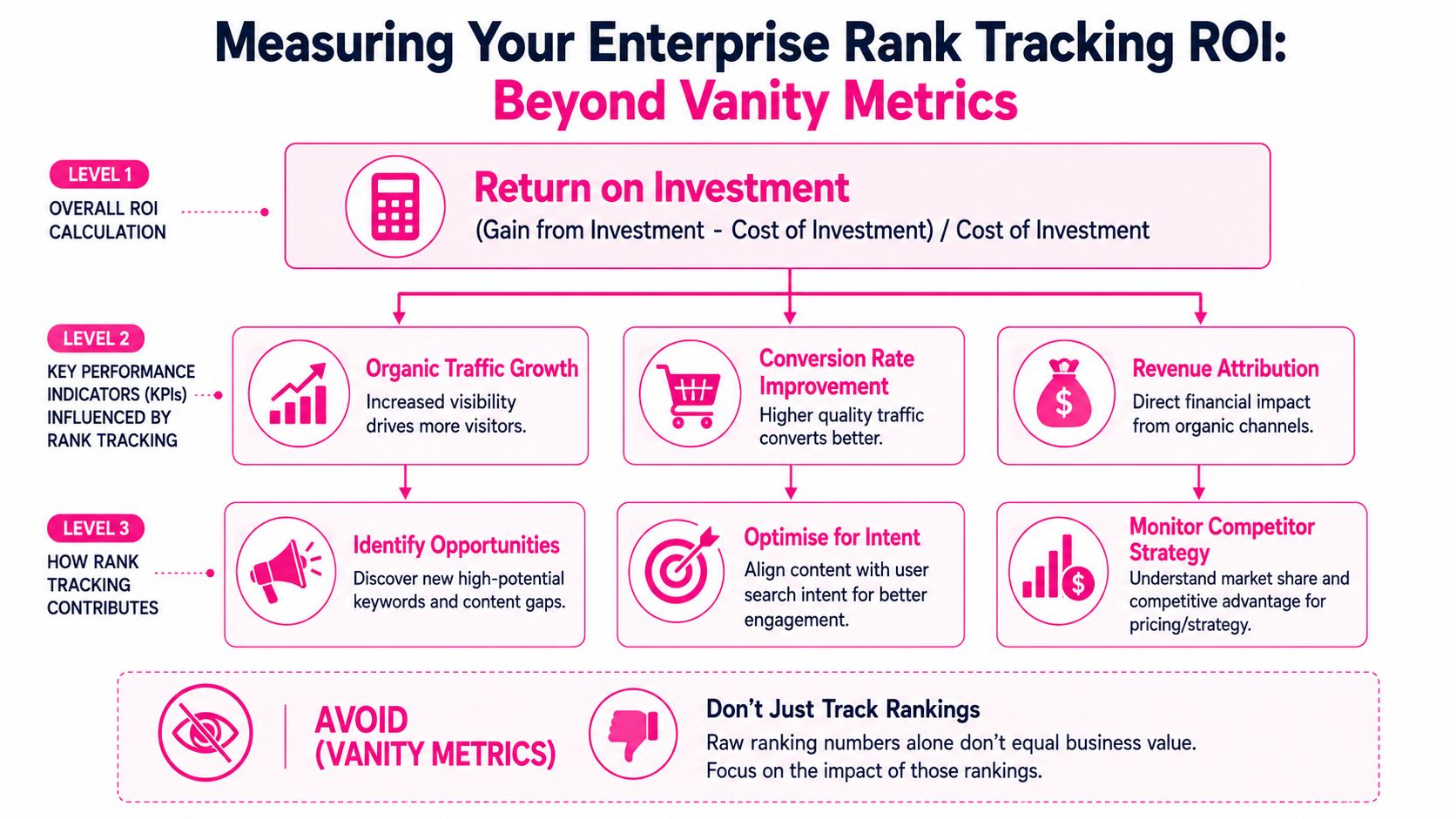
The common mistake is to stop at ranking improvement. That's exactly why so many programmes fail to convince finance teams. UK-specific enterprise guidance notes that 72% of multi-location UK retailers fail to correlate rank changes with local action data, which leaves CFOs unable to validate SEO ROI, according to this analysis of enterprise rank tracker performance.
Position is an input, not an outcome
A branch moving from position five to position two may be good news. But by itself, it doesn't prove business value. The commercial question is whether that movement increased calls, direction requests, bookings or visits.
The right framework starts with three layers:
- Visibility metrics such as local pack position and share of local presence
- Engagement metrics such as profile views, website clicks and call actions
- Business metrics such as branch-level leads, appointments or store traffic
That chain matters because it gives you causality you can discuss with finance and operations.
Build a branch-level measurement model
The cleanest way to measure ROI is to compare visibility movement with local action data over time by location cluster. Don't blend all branches together. Keep the reporting structure close to how the business runs.
A practical model usually includes:
- Location groups: Regions, franchise territories or branch cohorts
- Priority keywords: Terms tied to commercial intent, not vanity visibility
- Action metrics: Calls, direction requests, bookings or contact actions
- Operational notes: Openings, temporary closures, profile edits or review spikes
If you're also trying to refine credit across channels, it helps to review how teams compare marketing attribution models before over-claiming what rank data alone can prove.
Use KPIs that survive scrutiny
When a board pack lands on someone's desk, weak metrics collapse fast. Better KPIs tend to be the ones tied to real local demand.
A stronger dashboard focuses on:
| KPI | Why it matters |
|---|---|
| 3-Pack position | Shows whether the branch is visible where local intent is highest |
| Share of Local Voice | Indicates market penetration across the service area |
| GBP profile views month over month | Tracks whether visibility changes are reaching users |
| Click-to-action rate | Shows whether profile traffic turns into real action |
| Review response rate | Reflects operational health and customer trust signals |
UK local SEO guidance recommends tracking 3-Pack position, Share of Local Voice and GBP profile views month over month, with a click-to-action rate target above 8% and a review response rate of 90%+ within 48 hours, alongside separate monitoring for map pack and local organic rankings, as set out in this review of local SEO KPIs.
If your rank report can't be matched to branch actions, it's a visibility report, not an ROI model.
Tie the reporting back to decision-making
Good ROI reporting should change behaviour. If London South is losing map visibility but profile actions remain stable, you may monitor before intervening. If Birmingham East loses rankings and calls fall at the same time, the local SEO issue moves up the priority list.
Integrated reporting matters. Teams need local SEO insights that connect rankings to the signals local managers already care about, rather than asking stakeholders to interpret SEO metrics in isolation.
Selecting a Vendor and Best Practices
Buying software is the easy part. Designing a rollout that people will trust is the hard part.
Validate the data before you scale the rollout
A vendor demo can make almost any dashboard look convincing. What matters is whether the output holds up once you compare it against real search behaviour and first-party evidence.
For UK local SEO, the most dependable benchmark for aggregated ranking data across real searches in a target area is Google Search Console. To isolate local performance, you need to filter by country and then by city or location term within the query table. Search Console also lets you split Web from Local universal, which helps separate organic performance from local pack visibility, as outlined in this guide to local SEO rank tracking with Search Console.
That validation step is often skipped. It shouldn't be.
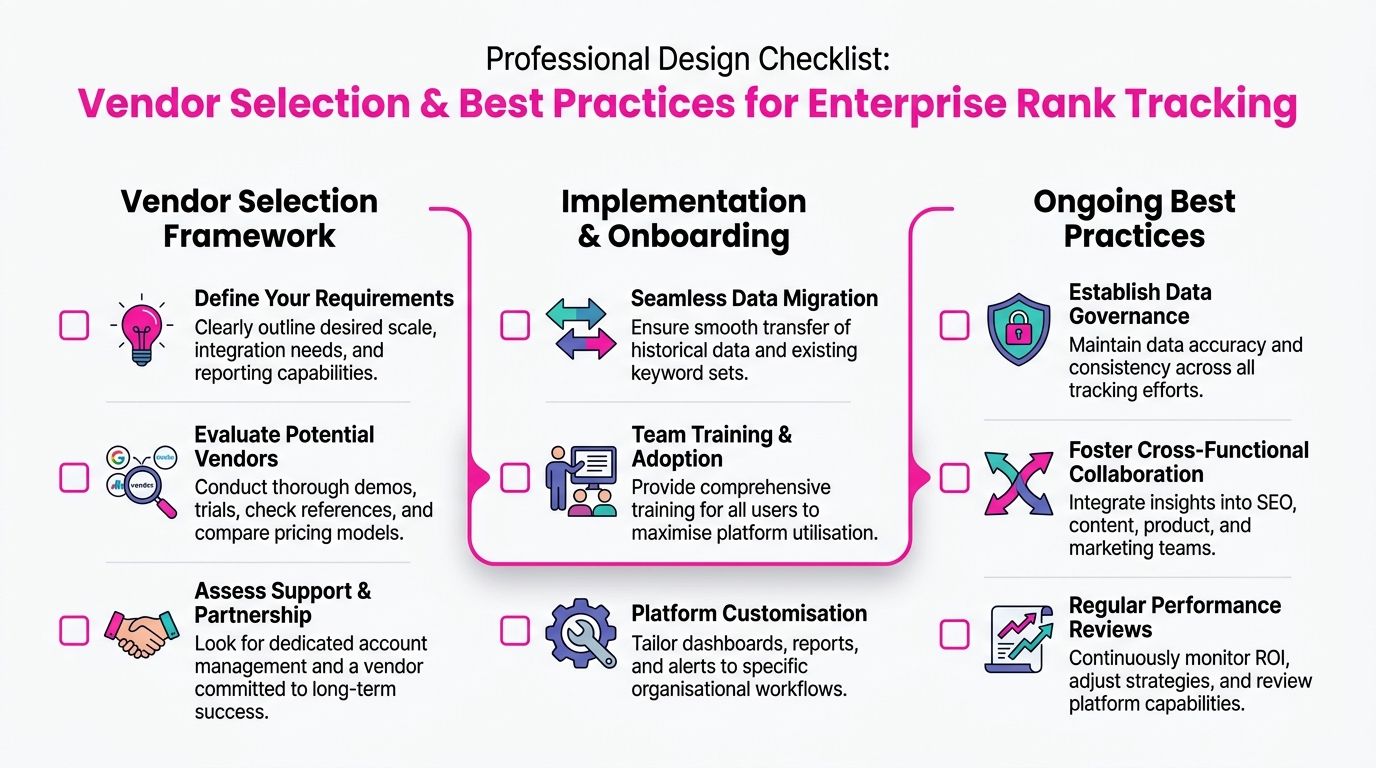
Choose vendors on operational fit, not promise
The right platform for an enterprise team usually wins on fit across four areas.
- Accuracy in local contexts: Can it track at the resolution your branches need?
- Scalability: Can it support growth in locations, keywords and reporting audiences?
- Segmentation: Can it report by franchise, region and business unit without awkward workarounds?
- Support quality: Can the vendor help your team design a working operating model, not just configure a login?
If your team wants a broader view of reporting and dashboard options, it's sensible to review Oviond recommendations for SEO tools alongside rank tracking demos. Reporting quality affects adoption more than many buyers expect.
Build the reporting structure around the organisation
One national report won't work for everyone. Franchise directors, regional managers and local marketing teams each need different cuts of the same data.
A practical setup usually includes:
- Executive roll-up reports: Concise visibility and action trends by region
- Regional operational reports: Branch comparisons, recent changes and alert-driven priorities
- Local branch views: A narrow list of issues tied to a specific market
- Exception reporting: Clear warnings when rankings drop in priority grids
This is especially important in franchise networks, where local accountability matters. If a platform helps with boosting local rankings for franchises, it should also support fair, segmented reporting that reflects how those franchises trade.
Don't let a vendor sell “single source of truth” if the only truth it can show is a national average.
Set process rules early
The most effective enterprise programmes usually agree a few operating rules from day one.
- Define keyword ownership so local teams don't add overlapping sets that muddy reporting.
- Agree refresh cadence by market type rather than applying one blanket schedule.
- Create alert thresholds for meaningful movement, not every minor fluctuation.
- Review with context so teams can explain closures, staffing issues, profile edits or local promotions.
The difference between a usable platform and an ignored one often comes down to those habits, not the software itself.
Turn Ranking Data into Market Dominance
Enterprise rank tracking isn't a reporting accessory. It's a control system for local visibility.
When a business has dozens or hundreds of locations, the problem isn't limited to knowing whether rankings moved. The problem is knowing where they moved, why they moved and which commercial teams need to react first. That's the gap between passive dashboards and active market management.
The UK challenge is sharper than generic SEO advice suggests. Dense cities create postcode-level variation. Franchise models create reporting tension between head office and local operators. Device differences complicate what “visibility” even means from one query to the next. A national average can hide all of that.
The enterprise teams that get this right do three things well. They track locally, they report by organisational reality rather than by SEO convenience, and they connect search movement to actions that branch leaders value.
That's also why ranking data should never sit on its own. If a weak area shows up in a geo-grid, the response may involve profile changes, review strategy, location page work or local publishing support. Search data becomes more useful when the team can move from diagnosis into action without jumping between disconnected systems. That's where tools like LocalHQ's content publisher become relevant, because local visibility gains rarely come from tracking alone.
If you run a national brand, a franchise network or a large multi-location operation, enterprise rank tracking belongs in the same conversation as regional performance, demand capture and commercial accountability.
If you need a clearer view of where your brand is winning and where local competitors are taking ground, LocalHQ gives you postcode-level geo-grid tracking, practical reporting and the tools to act on visibility gaps quickly. For multi-location teams, the most valuable feature isn't another generic ranking chart. It's a local rank tracking workflow that shows weak areas, ties them to real business actions and helps your team fix them before lost visibility turns into lost revenue.