

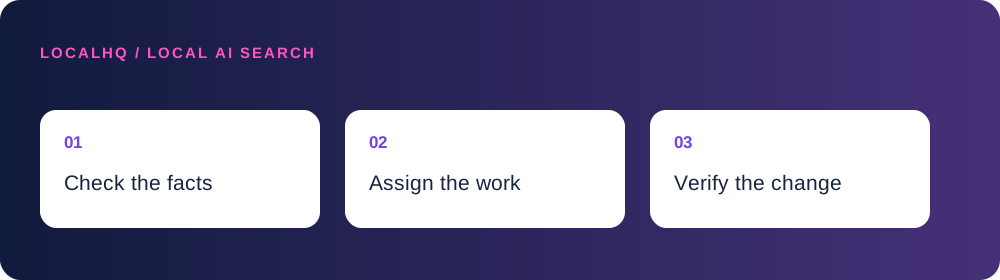
How to use this local AEO and GEO checklist
Choose one business location and one important service. Tick an item only when you have checked the evidence. For a multi-location business, repeat the location-specific items for each branch instead of assuming the head-office page represents them all.
This is a manual readiness checklist. It does not measure an AI engine’s internal ranking system or calculate the probability of a recommendation. The checkboxes are for this page session; print the page if you need a durable working copy.
For each gap, record the affected URL or profile, the person responsible and a practical next step. “Improve AI visibility” is too broad to assign. “Add the emergency call-out area and booking conditions to the service page” is a task someone can finish.
1. Make the business facts easy to verify
Check the trading name, telephone number, website and relevant address or service-area details against your own authoritative records.
Check ordinary hours, special hours, appointment rules and the actual route for contacting the business. Remove promises that the team cannot fulfil.
Confirm which branch provides each service. Explain service-area coverage accurately without inventing a public office.
Review Google Business Profile and the specialist or local directories customers use. Correct contradictions rather than building another layer of duplicate listings.
Start with the Google Business Profile audit for profile-focused checks. Keep its findings separate from observations of AI answers.
2. Give customers useful service and location pages
State what is included, who it suits, relevant exclusions and the information needed before booking or quoting.
Use sales enquiries to identify questions about cost, availability, suitability, preparation and what happens next.
Show verified packages where available. Otherwise explain the factors that change the price and how a quote is produced.
Include useful details about the actual branch or service area, rather than changing only a town name in repeated copy.
Check the telephone link, contact form, booking route or quote request on a mobile device. A good answer still needs a usable customer journey.
3. Support claims with credible evidence
Explain relevant experience, service methods and qualifications accurately. Do not claim awards, accreditations or results you cannot substantiate.
Publish approved case studies and authentic reviews with enough context to be useful. Do not manufacture reviews or edit quotations to add keywords.
Look at professional registers, specialist directories and real local coverage. Prioritise relevance and accuracy rather than a raw count of mentions.
4. Remove avoidable technical barriers
Ask a developer to investigate broken pages, server errors, login requirements and security challenges affecting public content.
Check that intended public pages are not accidentally noindexed and that canonicals point at the correct version. Keep deliberate exclusions deliberate.
Check current search-crawler guidance and hosting rules. Do not assume all AI bots have the same role or that a search permission also grants a training permission.
Do not put the entire service explanation, prices or contact details only inside images, downloads or an inaccessible interaction.
Match markup to the visible page and business facts. Validate it. Do not add fictional reviews, offers or a special “AI ranking” schema.
The LocalBusiness schema generator can help prepare markup. It does not replace checking the generated details against the actual business.
5. Observe AI answers with a consistent method
Choose service-plus-place questions a suitable customer might ask. Separate them from questions that already name the business.
Keep the exact wording, engine/mode and available location settings. Record whether a response used web search.
A named business, a linked source and a customer visit are different results. Do not combine them into an unexplained score.
Check what the linked pages actually say. Treat source patterns as leads for investigation, not proof of a universal ranking factor.
Re-run the same relevant questions on later occasions. Record the work completed so changes can be interpreted sensibly.
Explore LocalHQ’s AI Visibility Audit for the product workflow. An audit finding becomes useful when it leads to an action you can verify.
Turn the audit into a realistic work plan
| Priority | Example finding | Useful next action |
|---|---|---|
| Fix first | A public contact page fails to load. | Repair access and test the real enquiry route. |
| Next | A core service page does not explain coverage or quote factors. | Add the missing decision information and confirm it with the service team. |
| Investigate | A relevant directory is repeatedly cited but has outdated business details. | Check the listing, eligibility and correction process. |
| Monitor | One answer changed but no broader pattern is visible. | Repeat the defined checks before commissioning a large content change. |
Keep a short action register: finding, evidence, owner, due date and verification. Close a task when the information or customer journey is correct. Review visibility separately; finishing a task and receiving an AI recommendation are not the same event.
Sources and further reading
Primary guidance and product documentation checked on 30 October 2026. Platform features and access can change.