Fake Review Removal: What Works (& What’s a Waste)
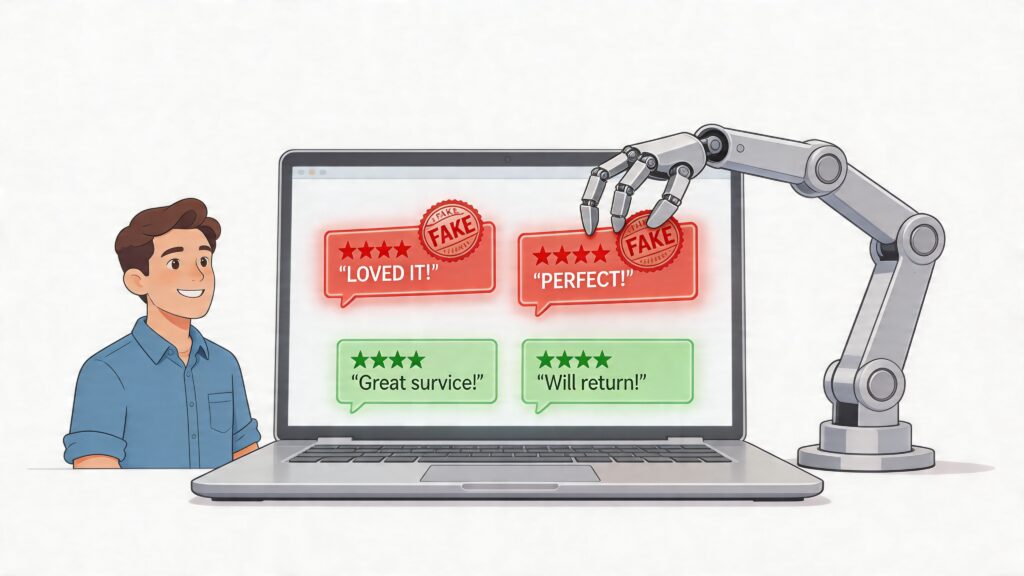
A fake review usually lands at the worst possible moment. You’re short-staffed, trading has dipped, and then a one-star comment appears from someone you don’t recognise, describing an experience that doesn’t match anything your team remembers. You report it, wait, refresh the listing, and nothing happens.
That’s the part most guides skip. Fake review removal isn’t a clean process. Sometimes the review comes down quickly. Often it doesn’t. Sometimes the platform agrees it looks suspicious but still leaves it live. Sometimes the fastest win isn’t removal at all, but controlling what real customers see while the complaint sits there.
If you run a restaurant, shop, clinic, agency or service business, you need a practical approach. Spot the fake properly. Report it with evidence. Respond in public without making things worse. Escalate only when the likely return justifies the hassle. Then build a stronger review base so one bad actor can’t do much damage.
How to Spot a Fake Review Before It Hurts Your Business
Not every harsh review is fake. Some are unfair but genuine. Some are clumsy, emotional, or factually muddled, yet still written by a real customer. If you mislabel legitimate criticism as fake, you weaken your own case and risk ignoring an operational problem that needs fixing.
The scale of the issue is still hard to ignore. In 2023, Trustpilot removed 3.3 million fake reviews globally, and 82% were identified by automated detection systems, which shows both how common fake reviews are and how much platforms rely on pattern recognition to police them (Trustpilot fake review statistics).
Look for language that sounds wrong
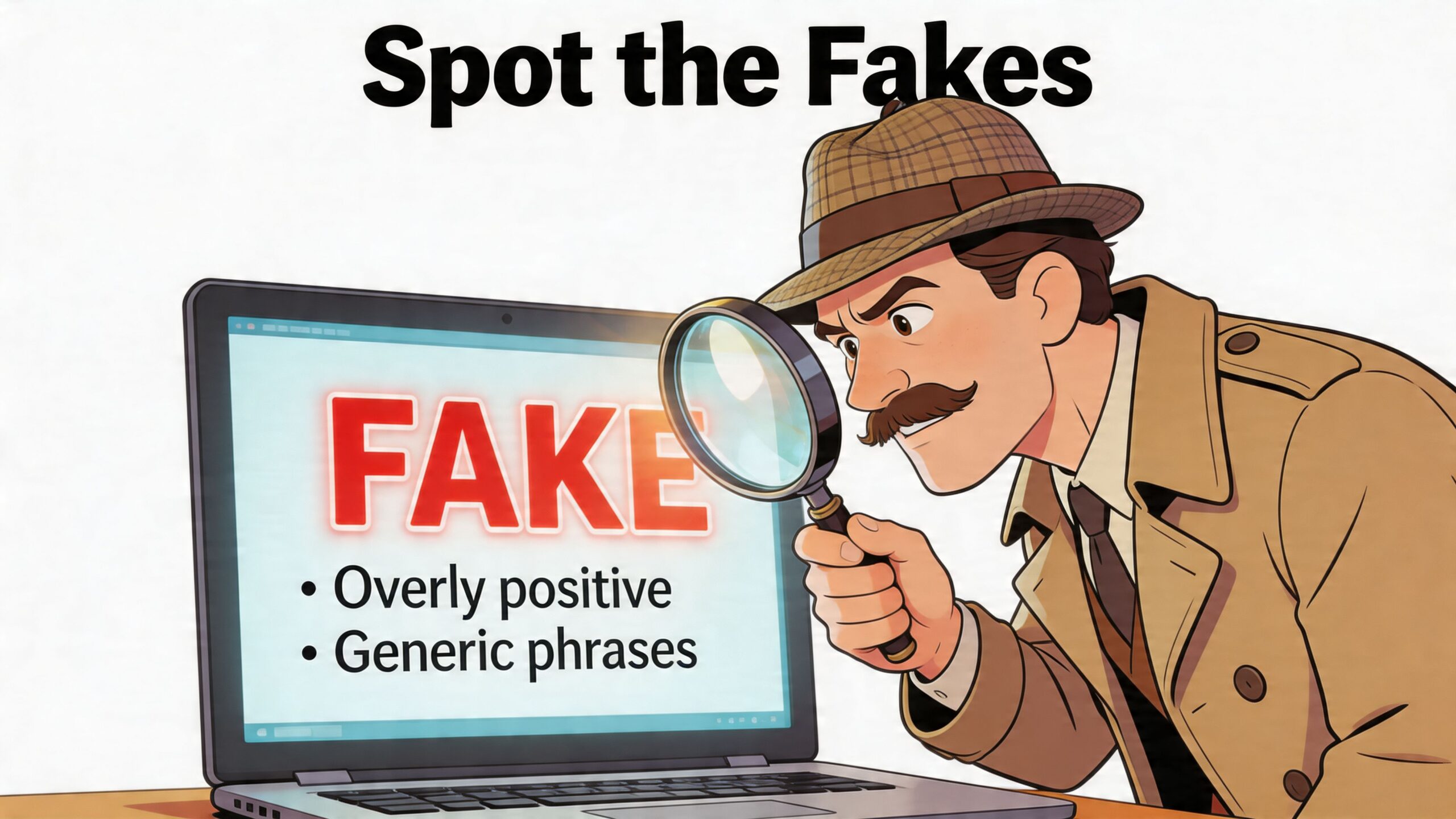
A fake review often reads oddly because the writer isn’t describing a real experience. They lean on generic outrage instead of specifics.
Watch for patterns like these:
- No concrete detail: The review says the service was “awful” or “disgusting” but names no staff member, product, booking time, order type, or actual issue.
- Wrong details: They mention a service you don’t offer, opening hours you’ve never had, or a location feature that doesn’t exist.
- Overwritten drama: The tone is extreme from the first sentence, with very little substance underneath it.
- Strange phrasing: Repeated wording, unnatural grammar, or language that feels copied and pasted across listings.
A real unhappy customer usually remembers something specific. Even when they’re angry, there’s normally a trail you can check.
Check the reviewer, not just the review
Many owners stare at the text and forget to inspect the account behind it. That’s a mistake.
Here’s what raises suspicion:
- Fresh account behaviour: A reviewer profile with little visible history can be a warning sign.
- Patterned activity: Similar comments posted across unrelated businesses suggest organised abuse.
- Category mismatch: A person who reviews multiple direct competitors in a short period deserves a closer look.
- Geographic oddities: If the account appears disconnected from your trading area and the review offers no believable context, document that.
Practical rule: Don’t decide from one clue alone. Fake review removal gets easier when you can show a cluster of problems, not just a gut feeling.
Use business context as evidence
The strongest fake review cases often come from operational facts inside your business.
Ask:
- Did this customer exist? Check bookings, job sheets, receipts, appointment logs, table covers, delivery records, or CRM notes.
- Does the timeline fit? If the review references a day you were closed, mid-refurbishment, or not offering that service, note it.
- Did several suspicious reviews appear together? A sudden burst of similar negativity can indicate coordinated activity.
- Is the allegation impossible to verify because it never happened? That matters if you can show you have no record of the interaction.
For multi-location brands, this gets trickier. Reviews are often posted against the wrong branch, and managers assume they’re fake when they’re just misplaced. Confirm the location before escalating.
Build a habit, not a panic response
Spotting fakes is a skill. Teams get better at it when they review suspicious content calmly instead of reacting emotionally the minute a one-star post appears.
A simple weekly review routine helps. Look at new reviews, compare them with customer records, note repeat reviewer names, and keep screenshots before anything changes. If you want a cleaner process for staying on top of mentions across locations, a proper online reputation monitoring workflow makes it easier to catch suspicious activity before it shapes customer perception.
Your Step-by-Step Guide to Reporting Fake Reviews
Once you’ve identified a review that looks false, stop improvising. Most failed reports aren’t rejected because the review looked legitimate. They fail because the business submitted a vague complaint with no structure, no evidence, and no clear policy reason.
Platforms increasingly rely on both automation and user reports. Trustpilot’s multi-layered system caught 82% of fakes in 2023, and it also received over 600k business flags in 2024, which tells you something important. Automated detection matters, but business reporting still plays a real role in enforcement (how platforms combine AI with business flagging).
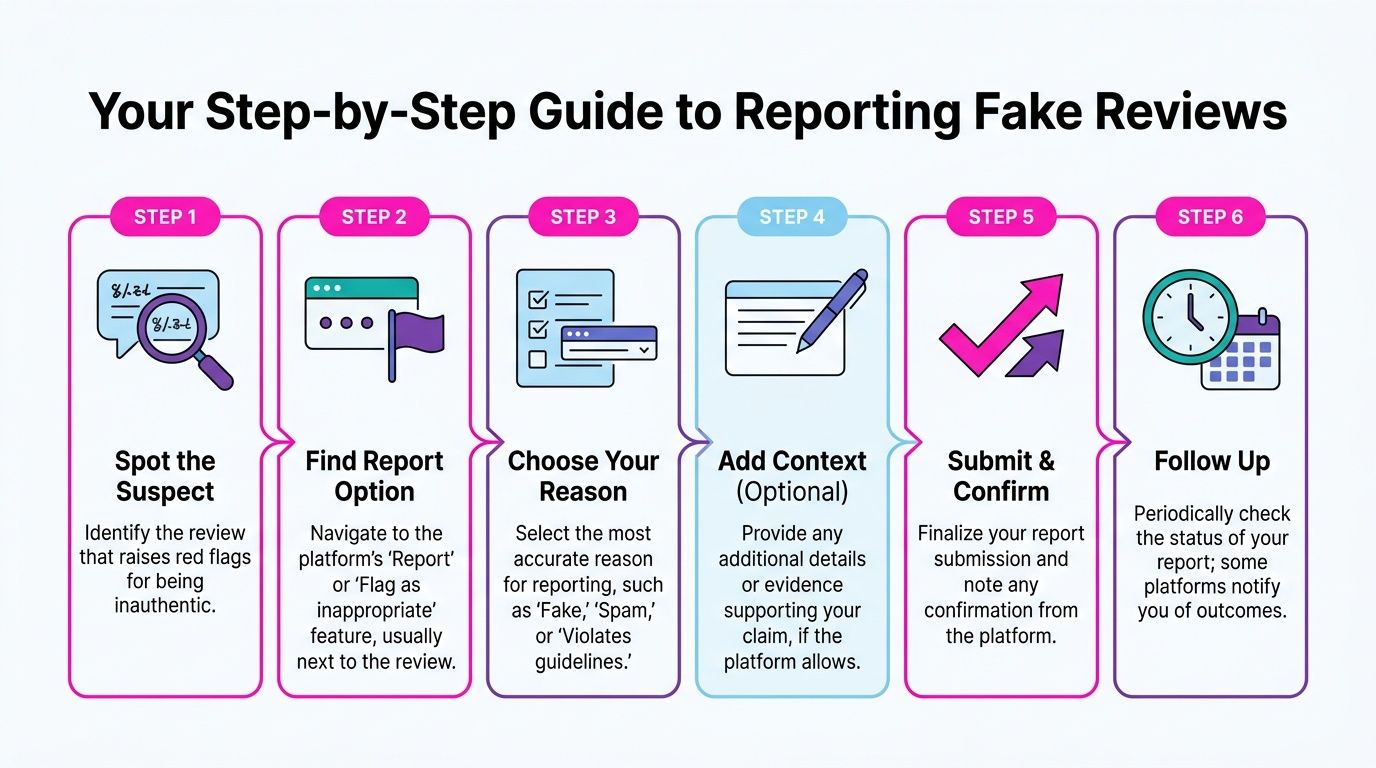
Gather evidence before you click report
Most owners do this in reverse. They hit “report”, write two annoyed sentences, then scramble for proof afterwards. That weakens the submission.
Collect these first:
- A screenshot of the review showing the text, rating, reviewer name and date.
- A screenshot of the reviewer profile if it shows suspicious patterns.
- Internal business records proving you can’t match the reviewer to a real transaction or booking.
- Relevant operational notes such as closure dates, service menus, appointment logs, delivery areas, or branch details.
- A short written summary explaining why the review is likely fake and which platform rule it appears to break.
Keep your explanation factual. “This is obviously from a jealous competitor” is weaker than “We have no customer record under this name, the reviewer describes a service this branch does not offer, and the post references a date when the business was closed.”
Report to Google properly
For most local businesses, Google Business Profile is the main battleground. That’s where fake reviews do the most visible damage.
Use this workflow:
Open your Google Business Profile
Access the review through your business dashboard or directly in Search or Maps.Find the review and use the reporting option
Select the menu next to the review and choose the option to report it.Choose the closest policy reason
Don’t pick randomly. Choose the reason that most accurately reflects the issue, such as spam, off-topic content, conflict of interest, or content that misrepresents a real experience.Write a brief supporting note if the platform allows
Keep it tight. State what can be verified and what cannot.Save your submission details
Screenshot the report confirmation or note the date and review text in your internal log.Monitor, don’t spam
Repeatedly filing the same report without new information usually wastes time.
If you want a more detailed platform-specific breakdown, this guide on fake reviews on Google is useful for matching common review patterns to the right reporting route.
Use stronger reasoning, not longer reasoning
A good report is short, specific and verifiable. A bad report is emotional.
Here’s the difference:
| Approach | Weak version | Strong version |
|---|---|---|
| Identity issue | “This person was never a customer.” | “We’ve checked bookings and transaction records and cannot match this reviewer to any customer interaction.” |
| Service mismatch | “They’re lying.” | “The review mentions a service this location does not provide.” |
| Timing problem | “This is fake and malicious.” | “The review refers to a date when the business was closed.” |
| Reviewer behaviour | “Looks suspicious.” | “The reviewer profile shows patterned activity that appears inconsistent with a genuine first-hand experience.” |
Report on other platforms with the same discipline
The mechanics change by platform, but the logic doesn’t.
For any review site:
- Identify the exact rule being broken
- Show why the content doesn’t reflect a genuine first-hand experience
- Attach or retain evidence
- Avoid speculation unless you can prove it
- Keep a dated record of every action taken
Public anger doesn’t help moderation teams. Clear evidence does.
What usually wastes time
A few tactics sound satisfying but rarely help:
- Arguing inside the report box: Moderators don’t need your full frustration diary.
- Submitting without evidence: Even obvious-looking fakes are harder to remove when the platform sees no context.
- Getting staff to mass-report from personal accounts: That can look manipulative.
- Threatening legal action in the first report: Save escalation for later if you have a serious case.
- Treating every negative review as fake: That pattern can make your account look less credible.
Build a repeatable internal process
Fake review removal is easier when someone owns it. In small firms, that may be the owner or general manager. In multi-site businesses, it should sit with one trained person or central team.
A practical internal checklist looks like this:
- Log the review quickly
- Check customer records
- Capture screenshots
- Submit one well-built report
- Set a diary reminder to review the outcome
- Draft the public response at the same time
That last point matters more than most businesses realise.
How to Respond While You Wait for Removal
The waiting period is where reputations drift. You’ve reported the review. You’ve got your screenshots. Now the comment is still sitting there, visible to every prospective customer who searches your name.
That’s why public response matters. Most advice on fake review removal focuses on the mechanics of reporting and gives very little space to the period afterwards, even though the 2-14 day waiting window is often where customer perception is won or lost (strategic response messaging gap in fake review handling).
What your response is really for
You’re not writing to convince the fake reviewer. You’re writing for everyone else.
Real customers scan for tone. They want to know whether you’re calm, organised and paying attention. A measured response tells them more about your business than a suspicious one-star review ever could.
The public reply should do four things:
- Acknowledge the concern without accepting a false claim
- Signal that you can’t verify the incident
- Invite an offline follow-up through a real channel
- Show that you take genuine feedback seriously
What to avoid
Businesses often make the situation worse by trying to “win” in public.
Don’t do this:
- Don’t accuse a competitor by name
- Don’t say the reviewer is lying unless you’re on very solid legal ground
- Don’t disclose customer data to disprove them
- Don’t sound rattled or sarcastic
- Don’t copy and paste the same defensive message on every review
If the review is fake, your response should still look professional to a neutral reader.
A good review response lowers doubt. A bad one spreads it.
Response templates you can adapt
Use these as a base, then tailor them to your business.
If you can’t identify the reviewer
“Thank you for your feedback. We take customer concerns seriously, but we’re unable to match this review to any recent booking or transaction at this location. We’d appreciate the chance to look into it properly, so please contact us directly with your name, date of visit and any relevant details.”
If the review mentions a service you don’t provide
“We’re sorry to read this, but the service described here isn’t offered by this location. If this review was posted in error, we’d be grateful if it could be amended. If you intended to contact us, please get in touch directly so we can clarify the matter.”
If you suspect a coordinated attack
“We’re currently reviewing this feedback because we can’t verify the visit described. We welcome genuine customer comments and are always happy to investigate specific concerns raised through our direct customer service channels.”
For more examples of wording that stays firm without sounding defensive, this guide on how to respond to a Google review is worth keeping handy.
Pair the response with positive review activity
While the report is pending, don’t fixate on the fake review alone. Ask recent genuine customers for feedback. Reply to legitimate reviews promptly. Keep your profile active and current.
This isn’t about burying the problem with noise. It’s about making sure prospective customers see a fuller and more representative picture of your business.
A simple rule for tone
If your draft reply sounds like something you’d regret seeing in a screenshot next month, don’t post it. Rewrite it until it sounds measured, courteous and boring in the best possible way.
That tone protects you twice. It reassures customers, and it reduces the risk of saying something careless while emotions are high.
Escalation Legal Options and When to Give Up
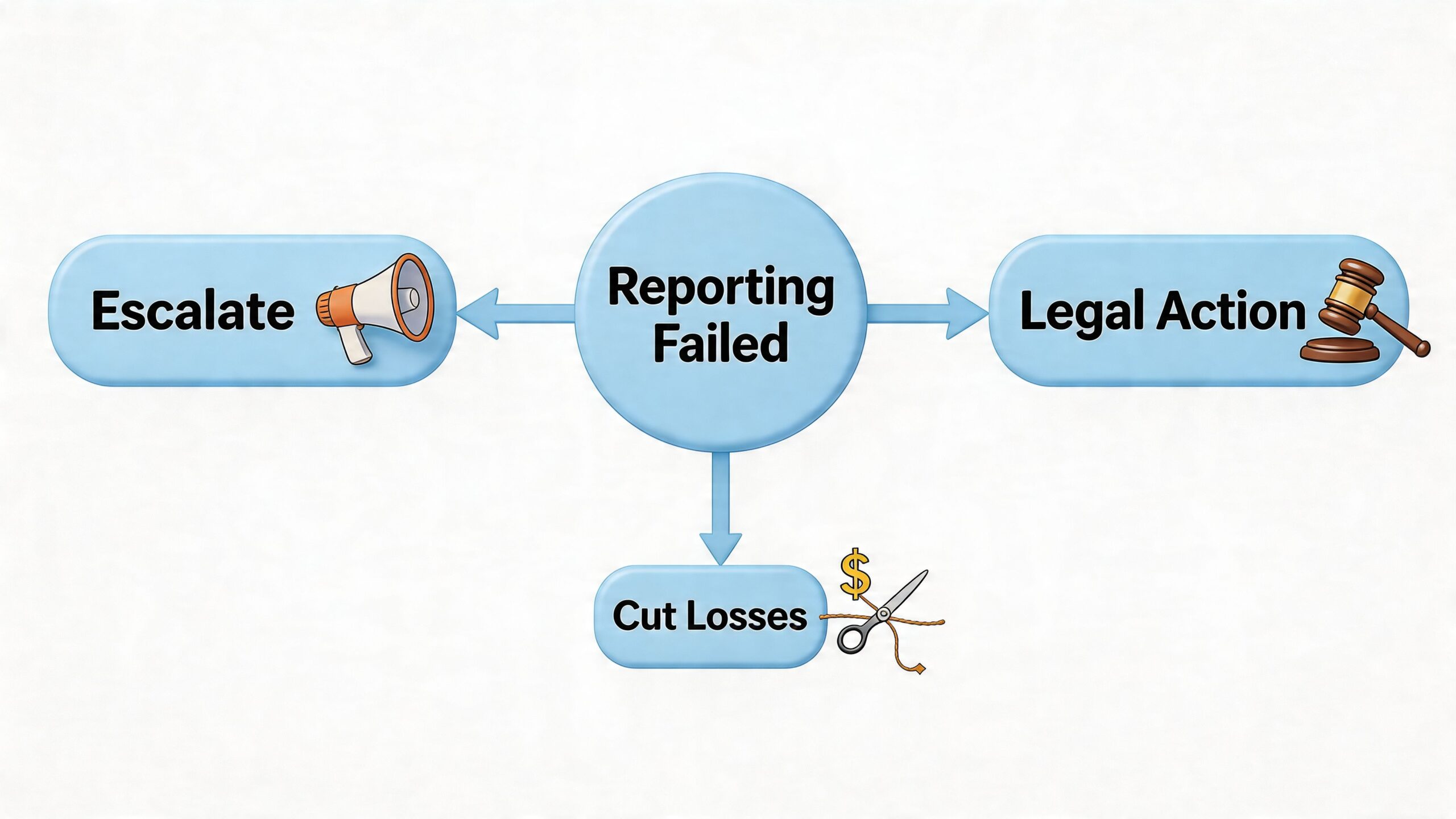
Some reviews won’t come down. That’s the blunt reality. You report them, appeal them, gather evidence, and the platform still leaves them in place. At that stage, the question changes from “How do I remove this?” to “What’s the smartest next move?”
There’s a documented effectiveness gap between DIY reporting and paid removal services, with some services claiming over 90% success rates, but there’s very little transparent data on the standard Google dispute process itself. That makes the return on escalation hard to judge for most UK businesses (the reporting versus paid service gap).
When an appeal is worth it
Appeal if you have new evidence, not just stronger feelings.
Good reasons to escalate include:
- You’ve identified a clear factual impossibility that wasn’t included in the first report.
- The review is attached to the wrong branch and you can prove it.
- You’ve found reviewer behaviour that suggests conflict of interest or coordinated abuse.
- The content includes something plainly against platform policy and your first report selected the wrong reason.
Bad reasons to escalate include annoyance, embarrassment, and the hope that a second submission from the same wording will somehow land differently.
When paid services can make sense
A removal service can be worth considering when the review is highly visible, clearly false, and materially affecting enquiry quality or customer trust. They usually add value in process discipline, evidence packaging and persistence. That’s different from magic.
Be cautious if a provider:
- Guarantees removal
- Won’t explain their method
- Suggests fake counter-reviews
- Pushes volume over evidence
- Avoids discussing platform policy
If you’re considering outside help, ask exactly what they need from you, how they frame disputes, and what happens if the review stays live.
Legal options in the UK
Legal action exists, but most small businesses should treat it as a serious escalation, not a default next step. Depending on the facts, that could involve a solicitor’s letter, a demand to cease defamatory publication, or advice around malicious falsehood or defamation.
That path tends to make sense only when the review is causing serious reputational harm, the author is identifiable, and the allegation goes beyond opinion into a provably false statement. Even then, legal pressure may be better used against the reviewer than against the platform.
For broader context on how regulators are tightening scrutiny around deceptive review practices, this note on the new FTC rule to ban fake reviews is a useful reminder that review manipulation is increasingly being treated as a serious compliance issue, not just a platform nuisance.
If removal will cost more in time, money and stress than the review is likely to cost in real business terms, stop chasing it.
When to let it go
This is the advice frustrated owners rarely hear. Sometimes giving up is the correct move.
Move on when:
| Situation | Better move |
|---|---|
| One suspicious review among many strong genuine reviews | Respond calmly and focus on fresh authentic feedback |
| The review is vague but not clearly removable | Leave a professional reply and monitor |
| You can’t prove it’s fake | Don’t over-escalate a weak case |
| The effort is draining management time | Redirect energy into operations and review generation |
The worst outcome isn’t always the fake review staying up. Sometimes it’s the owner spending weeks fighting one post while neglecting ten easier wins elsewhere.
Building a Proactive Defence Against Fake Reviews
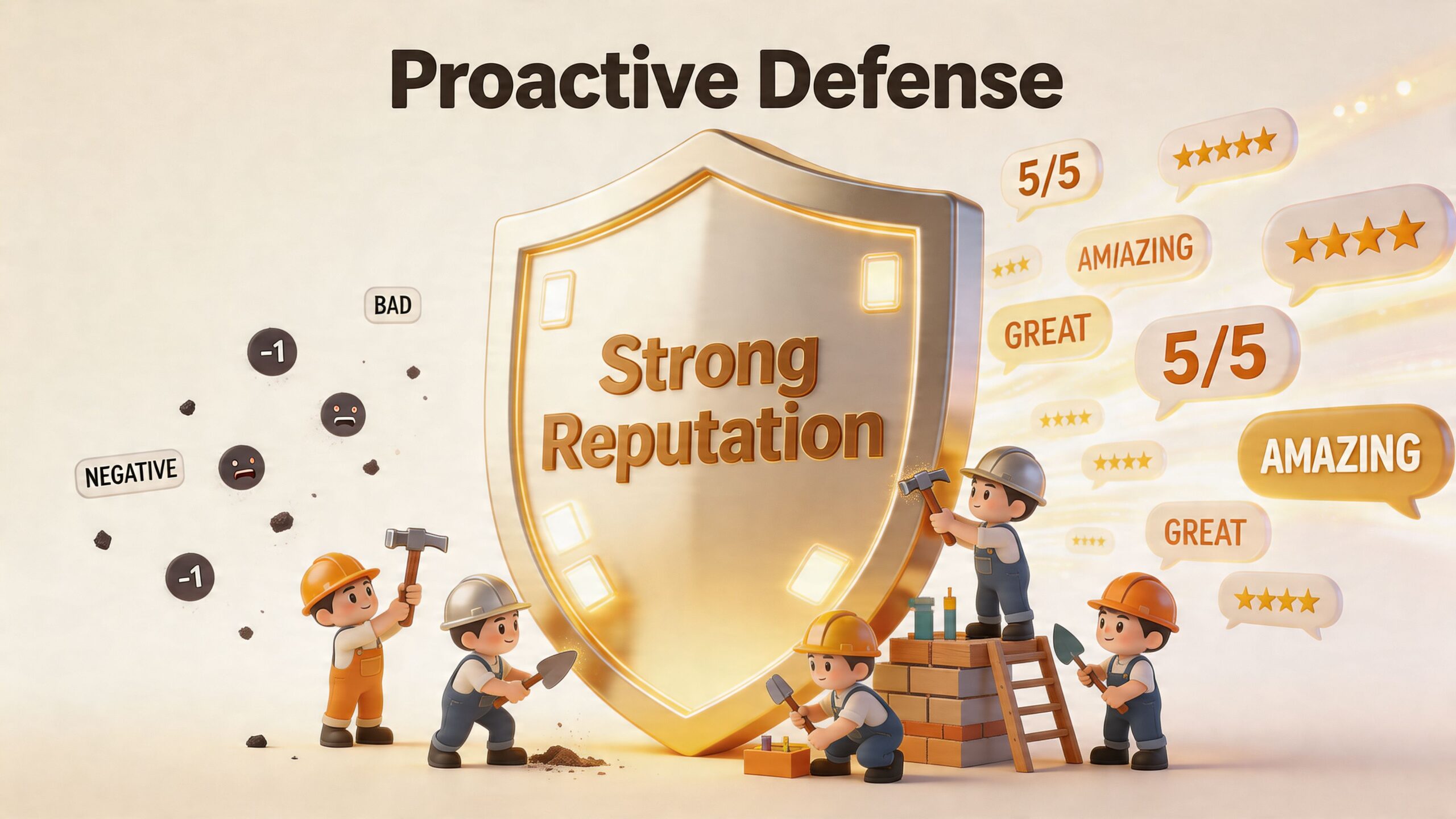
The strongest defence against a fake review isn’t a clever complaint. It’s a review profile that already looks healthy, recent and unmistakably genuine. When your business has a steady flow of authentic feedback, one rogue comment has less power to shape the whole picture.
That doesn’t mean fake review removal stops mattering. It means removal becomes only one part of a wider reputation system.
Make genuine review requests part of operations
The businesses that cope best with fake reviews don’t wait until there’s a problem. They ask real customers for feedback consistently.
That can come from:
- Point-of-sale prompts: A polite ask at the till, desk or reception.
- Post-visit follow-up emails: Short, simple, and sent while the experience is still fresh.
- SMS after completed jobs or appointments: Useful for service businesses where the customer has just seen the outcome.
- Staff training: Team members should know when and how to ask without sounding forced.
If you need a cleaner process for encouraging legitimate customer feedback, this guide on how to get more Google reviews covers practical ways to do it without crossing into incentives or pressure.
Build review quality, not just volume
A profile packed with thin, generic praise isn’t as resilient as one filled with believable, specific feedback. Encourage customers to mention the service they used, the branch they visited, or what stood out.
That helps in two ways. First, prospective customers trust detailed reviews more. Second, suspicious outliers are easier to spot when the rest of your profile reflects real experiences in plain language.
Keep your reputation signals consistent
Reviews don’t sit in isolation. Customers also judge your replies, your listing quality, your business information and the general tone around your brand.
That broader picture matters. If you want a useful outside perspective on why reputation needs managing as a whole rather than post by post, this piece on how to master overall brand reputation is a sensible companion read.
Create friction for fake review attacks
You can’t stop every bad actor, but you can make your business harder to damage.
Use a simple defence model:
- Monitor reviews daily or near-daily
- Reply quickly to genuine feedback
- Keep location details accurate
- Log suspicious activity centrally
- Train managers not to improvise public responses
- Maintain a regular cadence of new authentic reviews
A thin review profile is fragile. A mature one is much harder to distort.
Automate Your Defence with LocalHQ's Review Manager
Manual fake review removal work breaks down fastest in busy businesses and multi-location setups. Someone forgets to check one branch. Another manager replies too aggressively. Screenshots go missing. A suspicious review sits untouched because nobody realised it had come in.
That’s where a central workflow helps. LocalHQ’s Review Manager gives teams one place to monitor incoming feedback, flag questionable content, and manage responses across locations instead of relying on scattered logins and ad hoc spreadsheets.
The practical advantage isn’t hype. It’s consistency.
A useful setup should help you:
- See new reviews quickly so suspicious activity doesn’t sit unnoticed
- Standardise response handling so managers don’t post emotional replies
- Track patterns across branches when the same wording or reviewer behaviour appears more than once
- Keep a record of actions taken including reports, replies and follow-ups
- Support review generation efforts so one fake post has less weight against a stronger base of genuine customer feedback
For businesses using automation carefully, response tools are especially helpful during the removal waiting period. A review autoresponder can provide an approved first draft that staff then check and tailor. That shortens response time without turning your public profile into a wall of robotic copy.
The same goes for oversight. If you manage several sites, one dashboard is often the difference between catching a pattern early and discovering it after the damage is done.
Fake review removal is still part judgement, part evidence, and part persistence. No tool changes that. What a good system does change is the amount of manual chaos around it.
Frequently Asked Questions on Fake Review Removal
| Question | Answer |
|---|---|
| Can I sue a competitor in the UK for fake reviews? | Possibly, but only in stronger cases. You’d need legal advice on the exact wording, the evidence linking the review to the competitor, and whether the statement crosses from opinion into something provably false and harmful. For most small businesses, a solicitor’s letter is more realistic than a full claim. |
| Can one fake review affect local visibility? | It can, especially if your review profile is thin or the review is highly visible. The bigger issue is often conversion rather than ranking alone. People read ratings and replies together, then decide whether to call, book or visit. |
| Should I pay a review removal service? | Sometimes, yes. It makes more sense when the review is clearly false, commercially damaging, and you’ve already tried the platform route properly. Be wary of guarantees and avoid any service that suggests posting fake positives in return. |
| What if the platform refuses to remove the review? | Leave a calm public response, document the issue, and focus on earning fresh genuine reviews. If you later uncover stronger evidence, then an appeal may be worth it. |
| How do I know whether a review is fake or just unfair? | Start with records. Check whether the customer existed, whether the timeline fits, and whether the details match your actual service. Unfair reviews are common. Fake ones usually leave factual gaps or behavioural clues. |
If fake review removal is eating management time, the smarter move is usually better monitoring, faster response handling and tighter review workflows. LocalHQ helps businesses manage that in one place, especially when multiple locations, multiple reviewers and delayed removals make manual tracking messy.