Master Local Advertising Google in 2026
Paid listings are no longer a side feature in local search. In the UK, sponsored ads now appear in approximately 22% of all tracked local pack keywords, up from less than 3% two years earlier, and Local Services Ads have expanded from 11% to 31% of tracked queries according to Sterling Sky reporting cited by 365i. That changes the job completely. Local visibility now depends on how well your paid and organic presence work together.
For most businesses, local advertising on Google fails for ordinary reasons. The profile is weak, the targeting is sloppy, the budget is spread too thin, and nobody tracks what happens after the call. The businesses that win tend to get the basics right first, then tighten the technical settings, then measure offline outcomes properly.
The Foundation Your Local Ads Cannot Succeed Without
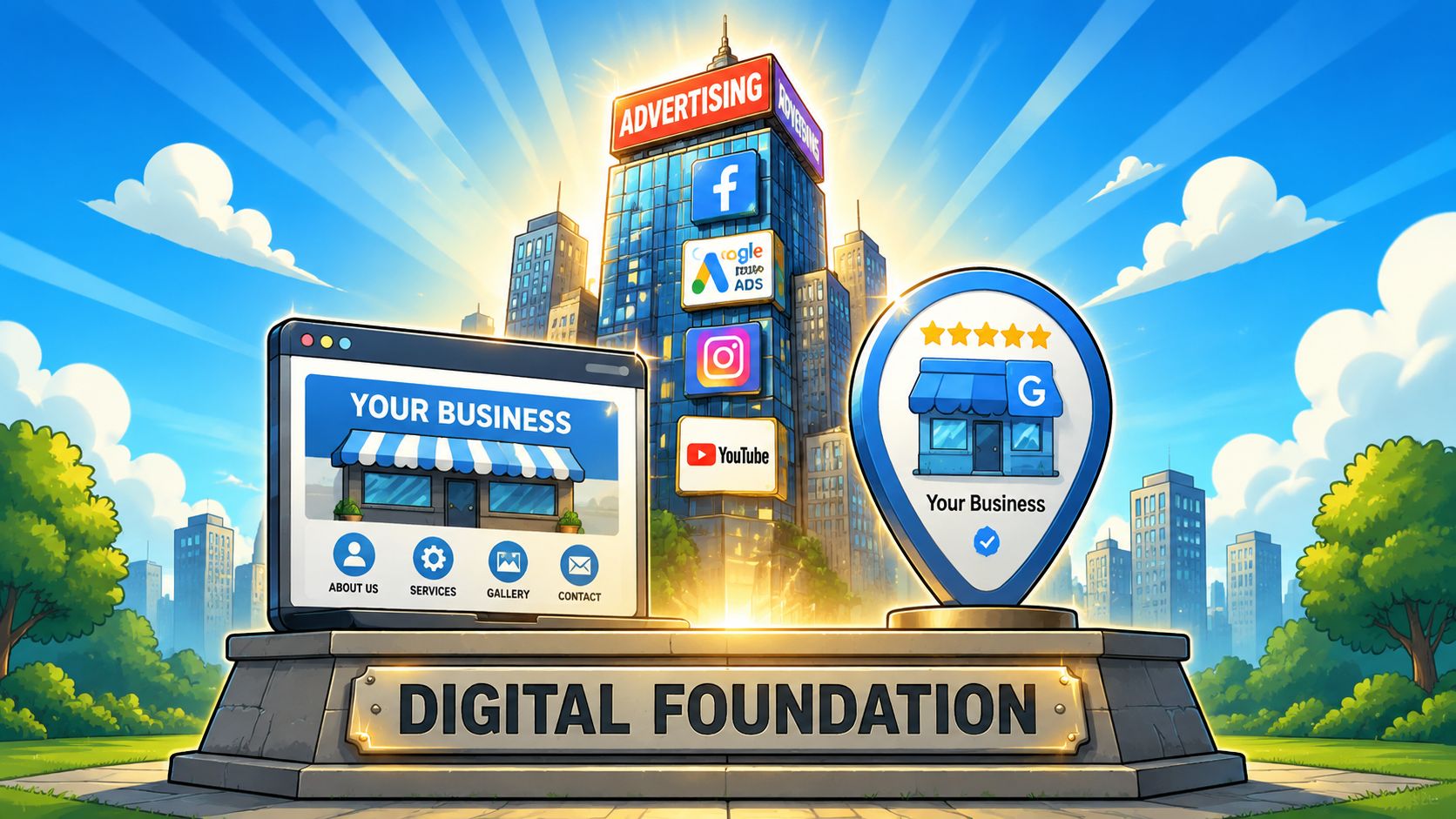
Paid traffic magnifies whatever is already there. If your Google Business Profile is incomplete, poorly categorised, or inconsistent with the landing page, ads won't fix it. They'll send more people into a weak first impression.
Build the profile before buying the click
Start with the commercial basics inside Google Business Profile:
- Choose the right primary category: This influences how Google understands the core service. Pick the category that matches the revenue-driving offer, not the broadest label.
- Add useful secondary categories: These help cover adjacent services without diluting the main offer.
- Write a service-led business description: Keep it clear, local, and aligned with what people search for.
- Use real imagery: Show the premises, team, vans, treatment rooms, menu items, or shop floor. Generic stock images weaken trust.
- Complete Q&A and service details: If people ask the same pre-sale questions by phone, answer them in the profile too.
If you need a solid process for this, this guide on boosting local visibility with Google Business Profile is a useful reference point.
Use profile metrics as your baseline
Before launching campaigns, look at what the profile already generates on its own. Google Business Profile metrics specifically track offline actions that never touch the website, including phone calls, direction requests, website clicks, messages, and bookings, which makes them some of the clearest signals of local buying intent for bricks-and-mortar and service businesses, as outlined by ReportsMate.
That baseline matters. If a profile already earns calls and direction requests, ads can scale an existing pattern. If it generates very little engagement, the problem often sits in positioning, category choice, review quality, or offer clarity rather than media spend.
Practical rule: Don't launch local advertising Google campaigns from a neglected profile. Sort the profile first, then pay to amplify it.
Match the ad promise to the profile experience
Clicks get expensive when the ad says one thing and the profile or landing page says another. A user searching for “emergency boiler repair Leeds” expects immediate availability, visible contact options, and proof that you serve that area. If the profile looks generic, they bounce mentally even if they don't leave the page.
The same principle applies to reviews. Don't chase volume for the sake of it. Chase reviews that mention the actual service, location, and outcome. Those details help both credibility and conversion quality.
For teams refining campaign structure and reporting, it's worth studying broader PPC advertising strategies as well, especially if you're trying to align local intent with measurable actions rather than just clicks.
Choosing Your Ad Type Local Campaigns or Services Ads
UK local advertisers rarely need every Google format at once. The right starting point depends on how the customer buys, how quickly they need you, and whether the sale happens on a phone call, in a van, or at the premises.
If you run a restaurant, shop, clinic, or showroom, visibility across Maps, Search, YouTube, and Display can lift calls, direction requests, and store visits. In practice, that points to Local Campaigns now delivered through Performance Max. If you run a plumbing firm, locksmith service, solicitor's office, or another lead-driven service business, Local Services Ads often fit the path to enquiry better because they are built around service categories, service areas, and lead screening.
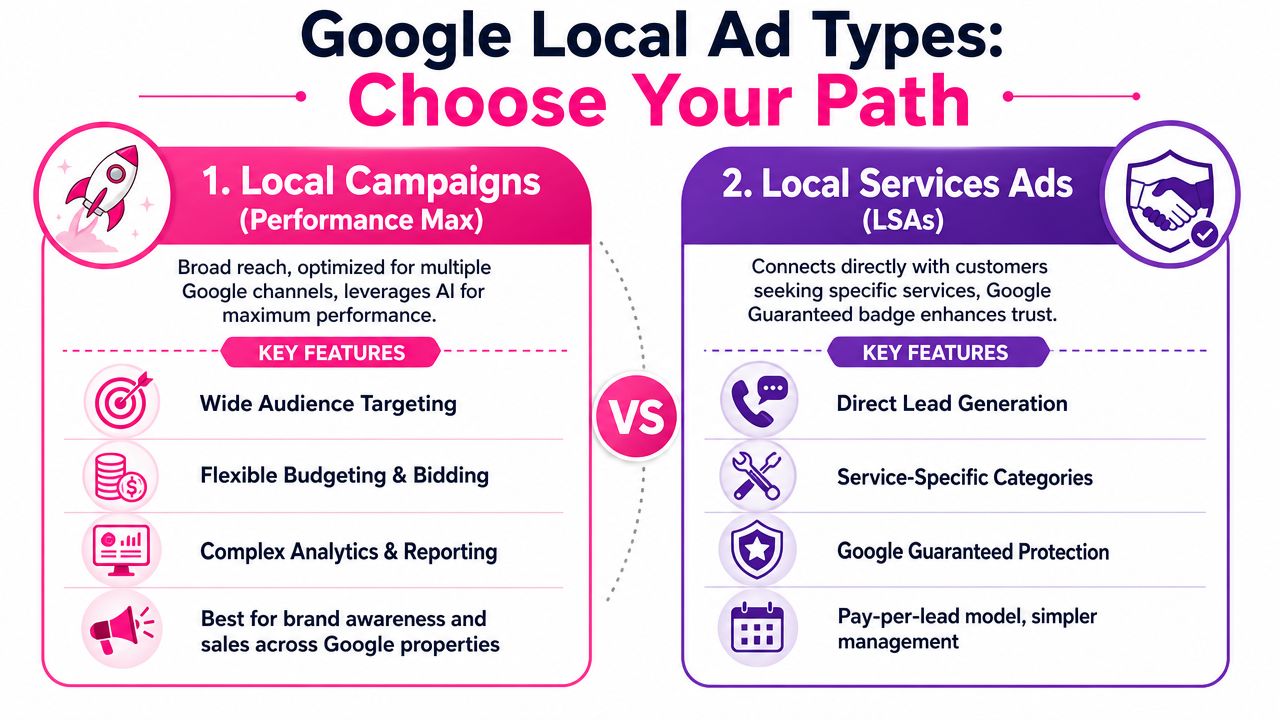
The practical difference
| Feature | Local Campaigns (via Performance Max) | Local Services Ads (LSAs) |
|---|---|---|
| Primary use case | Driving footfall, calls, directions, and broader local demand | Driving direct enquiries for eligible service categories |
| Cost model | Pay per click. UK Google Ads average CPC across industries sits between £3.50 and £3.65 according to White Hat SEO | Pay per lead. Average UK lead costs generally fall between £10 and £50 depending on industry and area, according to the same source |
| Best for | Retail, restaurants, hospitality, clinics, showrooms, multi-location brands | Home services, legal, healthcare, and other trust-sensitive service providers |
| Targeting style | Broader multi-surface local reach through Google's automated system | Service area and service category led enquiry capture |
| Management complexity | More assets, audience signals, feed inputs, and reporting interpretation | Simpler front-end management, but lead quality review still matters |
| Qualification requirements | Standard Google Ads setup linked to business assets | Eligibility and verification requirements apply before ads can run |
Which one should go first
Choose Performance Max first if local discovery matters. That usually means category searches, comparison behaviour, map browsing, and visits influenced by photos, opening hours, offers, and proximity.
Choose LSAs first if the search is urgent and the next step is a call or message. Boiler breakdowns, pest control, emergency locksmith work, family law enquiries, and similar services often convert faster through an ad unit built for immediate contact.
I usually frame it this way with clients. If the prospect wants to visit you, Performance Max often deserves the first budget line. If the prospect wants you to visit them, LSAs usually deserve it.
Why many UK businesses should run both
For service businesses, the stronger setup is often a joined-up one. LSAs capture the high-intent lead. Performance Max keeps the business visible in Maps and across Google surfaces where buyers compare providers before they call. Google Business Profile supports both by supplying location trust signals, reviews, and the profile actions that often tip a user into contacting you.
That combination is where local advertising Google starts acting like a system instead of three separate tools. One channel catches demand already in market. Another keeps you present in the wider local area. Your profile does the conversion work in the middle.
If you want an outside view on lead handling and setup decisions, this piece on an effective Google LSA approach is useful alongside your own testing. Paid performance also improves when you optimise your Google Business Profile so calls, reviews, service areas, and category signals line up with the ad traffic you are buying.
Setting Budgets and Hyper-Local Targeting in the UK
A small local budget disappears fast if Google is allowed to roam outside the postcodes you can serve. I see this more often than weak ad copy. The account is active, clicks are coming in, but the wrong towns are eating spend and the phone stays quiet.
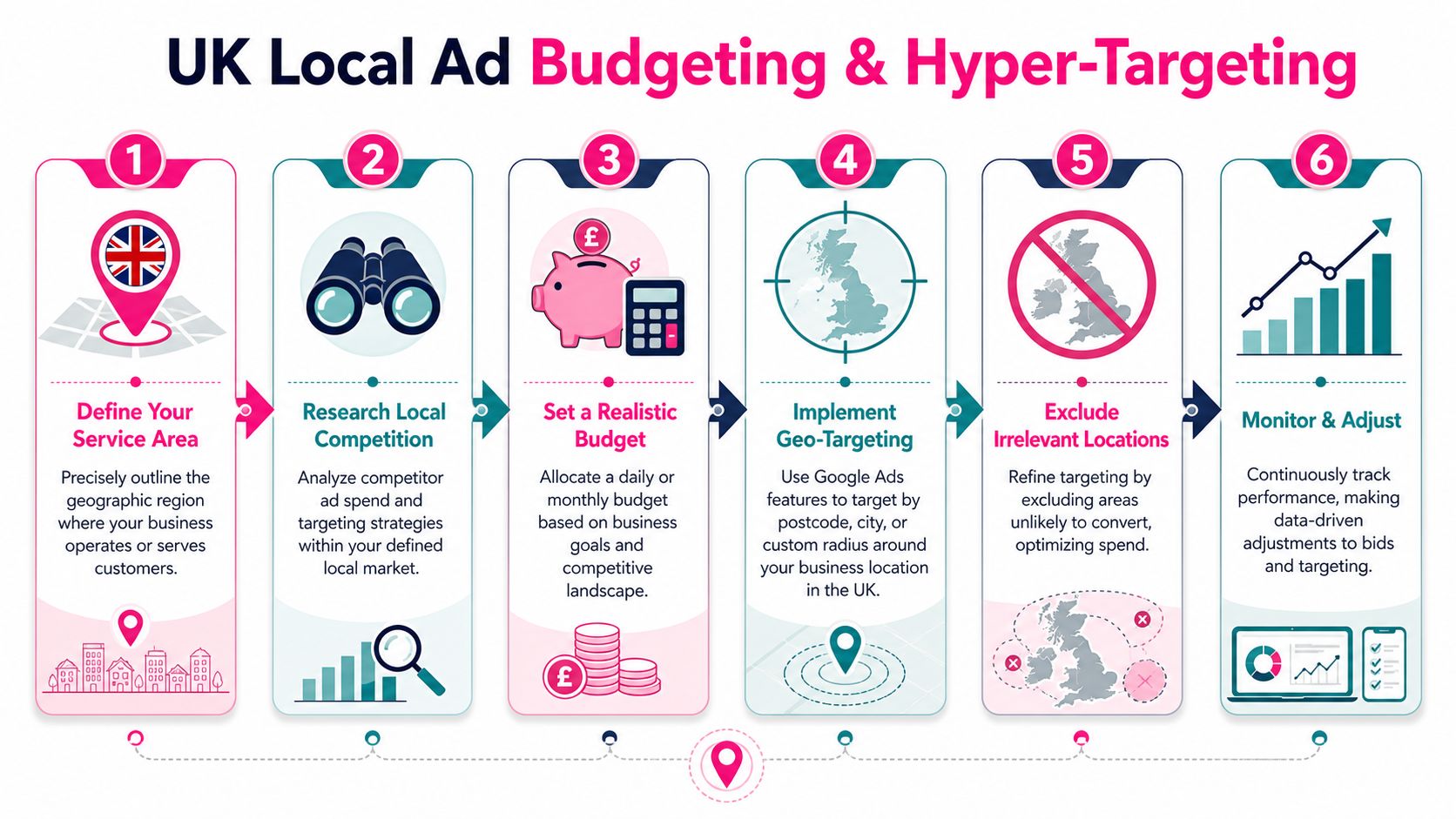
Start with a budget that can produce usable data
As noted earlier, UK click costs can rise quickly in competitive sectors, so the key question is not "what is the cheapest budget?" but "what budget gives this campaign a fair test?" For many local businesses, that means enough spend to cover branded searches, a tight set of core service terms, and at least a few weeks of clean data before making hard decisions.
For Maps-led visibility and local intent capture, Bare Digital's guide to advertising in Google Maps gives a sensible entry point for smaller advertisers. In practice, I would still split budget by intent, not by platform label. Protect your brand first. Fund the service and location combinations that bring calls or store visits. Leave some headroom for search term pruning and postcode exclusions, because local campaigns nearly always need both.
A modest budget can work. A vague budget rarely does.
Set location targeting to people who are actually there
One setting causes an outsized amount of waste in UK local accounts. The default location option often includes people outside your trading area who have only shown interest in it. That is fine for tourism or national ecommerce. It is expensive for a dentist in Leeds, a tyre fitter in Croydon, or a plumber who only covers a 12-mile patch.
Bare Digital's Google Ads for local businesses explains why the tighter "Presence" setting matters for local targeting. Use that option if you need calls, bookings, or visits from people physically in the area. Then line it up with your service reality. If you would not send a technician there, do not target it. If parking, congestion charges, or travel time kill margin, exclude it.
That discipline matters even more if you are running Google Business Profile, Performance Max for store goals, and Local Services Ads together. The whole system works better when every channel points at the same real catchment area instead of three different versions of it.
Build around postcodes and travel logic, not a lazy radius
Radius targeting is quick to set up, but it hides the places that generate revenue. A 10-mile circle can include affluent postcodes, low-response estates, city-centre traffic headaches, and villages that look close on the map but take 35 minutes to reach.
OneBase Media's location targeting breakdown is a good reference for structuring tiers by area performance. The practical method is straightforward. Put your strongest postcodes in one layer, your acceptable service area in another, and cut anywhere that consistently produces poor leads or expensive journeys. For service businesses, I usually review this against call quality and job value, not click-through rate.
That matters because local ROI is usually won in the gap between lead volume and lead value. Two enquiries from the right side of town can beat ten from the edge of your map.
If you are sending paid traffic to local pages, keep the geography consistent between ads, landing pages, and your Google Business Profile. This guide to a local SEO strategy for 'near me' searches is a useful reference when you need page-level relevance for towns, boroughs, or service clusters.
Crafting Ad Creative That Speaks to Locals
Plenty of local ads fail before the click because they sound like they could belong to any business in any town. Local relevance isn't a decorative extra. It's what makes someone think, “Yes, they're near me and they understand what I need.”
Write like a local business, not a national template
The strongest local ad copy usually does three things well:
- Names the place clearly: Use the town, district, or neighbourhood where it helps the searcher decide quickly.
- Mentions the actual service problem: “Blocked drain”, “same-day tyre fitting”, “private dining in York city centre” is stronger than vague brand language.
- Sets the next action: Call, book, visit, get directions, or request a quote.
Don't cram every location into one ad group. If you serve multiple places, create tighter asset groups or campaigns around meaningful service areas. That gives you cleaner copy and a better chance of matching what the user typed.
Show proof that you operate there
Images matter more in local campaigns than many advertisers admit. Use real photos of your frontage, treatment rooms, team members, service vehicles, dining area, or completed work. People clicking local ads often want a confidence check before they call.
A local landing page doesn't need to be elaborate, but it does need to answer immediate questions fast:
- Where are you?
- Do you cover my area?
- What exactly do you offer?
- How do I contact you now?
Put the phone number high on the page. Make the address easy to spot. If bookings matter, don't bury the booking button below a wall of brand copy.
The best local ad creative reduces uncertainty. It doesn't try to sound clever.
Keep the page and profile language aligned
If your ad talks about emergency callouts, same-day tables, or city-centre collection, the page and profile must reinforce that. Consistency across ad text, business description, service labels, and on-page headings helps both user confidence and conversion flow.
For teams refining that language, a good GBP copywriting framework can help keep descriptions practical, local, and commercially focused.
Measuring Real-World Results and Proving ROI
Clicks are easy to count. Revenue is harder. That's why so many local campaigns get judged on the wrong scoreboard.
Track the actions that indicate local intent
Google Ads can report local actions conversions when someone uses a Business Profile action such as clicking call or directions, and Google explains these can be filtered at both conversion-action and campaign level in its local actions documentation.
Those metrics are useful because they connect ads to behaviour that often leads to offline business. For shops, clinics, restaurants, and many service brands, a directions click can matter as much as a form fill.
Still, those actions only tell part of the story. They show intent, not outcome.
Close the loop with offline conversion imports
The deeper problem appears in service businesses. A phone call isn't automatically a sale. A lead form isn't automatically a qualified job. Google's UK Local Services guidance highlights a common gap: businesses often stop measurement at the lead stage and fail to use offline conversion tracking to distinguish a basic enquiry from a closed, revenue-generating deal in its LSA support documentation.
That matters because the campaign can look healthy while sales teams reject half the leads.
A practical workflow looks like this:
- Capture the lead source correctly: Calls, forms, booked appointments, and messages need consistent attribution.
- Push outcome data into your CRM or job system: Mark whether the lead was qualified, quoted, won, or lost.
- Import closed outcomes back into Google Ads: This tells the platform which leads turned into actual revenue.
- Optimise against value, not noise: Once the feedback loop is clean, bidding decisions improve.
Cheap leads often become expensive customers to acquire. Qualified, closed business is the metric that matters.
If you need a broader commercial framework around attribution, this guide for small business marketing ROI is a helpful companion read.
Agencies handling this for multiple clients also need reporting that translates platform data into business outcomes. A practical starting point is this guide for agencies on client SEO reports, especially when calls, bookings, and direction requests matter more than vanity metrics.
Scaling Your Local Advertising Without the Headache
One location is manageable. Ten locations expose every weak process you've got.
Manual local campaign management tends to break in predictable places. Categories drift. profile updates get missed. Ad copy stops matching local offers. Reporting lives in separate spreadsheets. Nobody can compare performance cleanly across towns, regions, or franchise groups.
Multi-location growth needs central control with local flexibility. The winning setup usually includes shared standards for profile completeness, campaign naming, asset quality, geo-targeting rules, and reporting. Local managers still need room to reflect opening hours, service nuances, seasonal offers, and area-specific messaging, but the system around them has to stay consistent.
That's especially important when you're running several moving parts at once: Google Business Profile activity, Performance Max for local reach, and LSAs for direct enquiries. Without a common dashboard and process, optimisation becomes reactive and messy.
The businesses that scale local advertising Google well don't rely on heroics. They rely on repeatable workflows, location-level accountability, and reporting that surfaces what changed, where, and why.
If you're ready to stop juggling separate tools and spreadsheets, LocalHQ gives you one place to manage Google Business Profiles, monitor calls and direction requests, keep listings consistent across locations, and turn local performance into reporting you can act on. For any business serious about local advertising on Google, that operational control is the feature that keeps growth manageable.