Top White Label SEO Programs for Agencies in 2026

Growth stalls in a very specific way for agencies. You don't usually run out of demand first. You run out of delivery capacity. SEO fulfilment starts eating the week, reporting takes longer than it should, and every new client feels like a staffing problem rather than a revenue win.
That's the moment most agencies start looking at white label seo programs. The right partner lets you keep the client relationship, expand what you sell, and stop building operations the hard way. The wrong one gives you generic deliverables, awkward reporting, and a margin squeeze you notice three months too late.
For UK agencies, the choice is a bit more nuanced. Some tools are software platforms that help your team execute faster under your own brand. Others are fulfilment partners that do the work for you. Both models can work. They solve different bottlenecks.
The UK digital marketing consultancy sector is projected to reach £8.2 billion by 2028, with a 12.8% CAGR from 2023 to 2028. That growth explains why so many agencies are trying to systemise delivery now, especially around local SEO, multi-location work, and recurring reporting.
1. LocalHQ
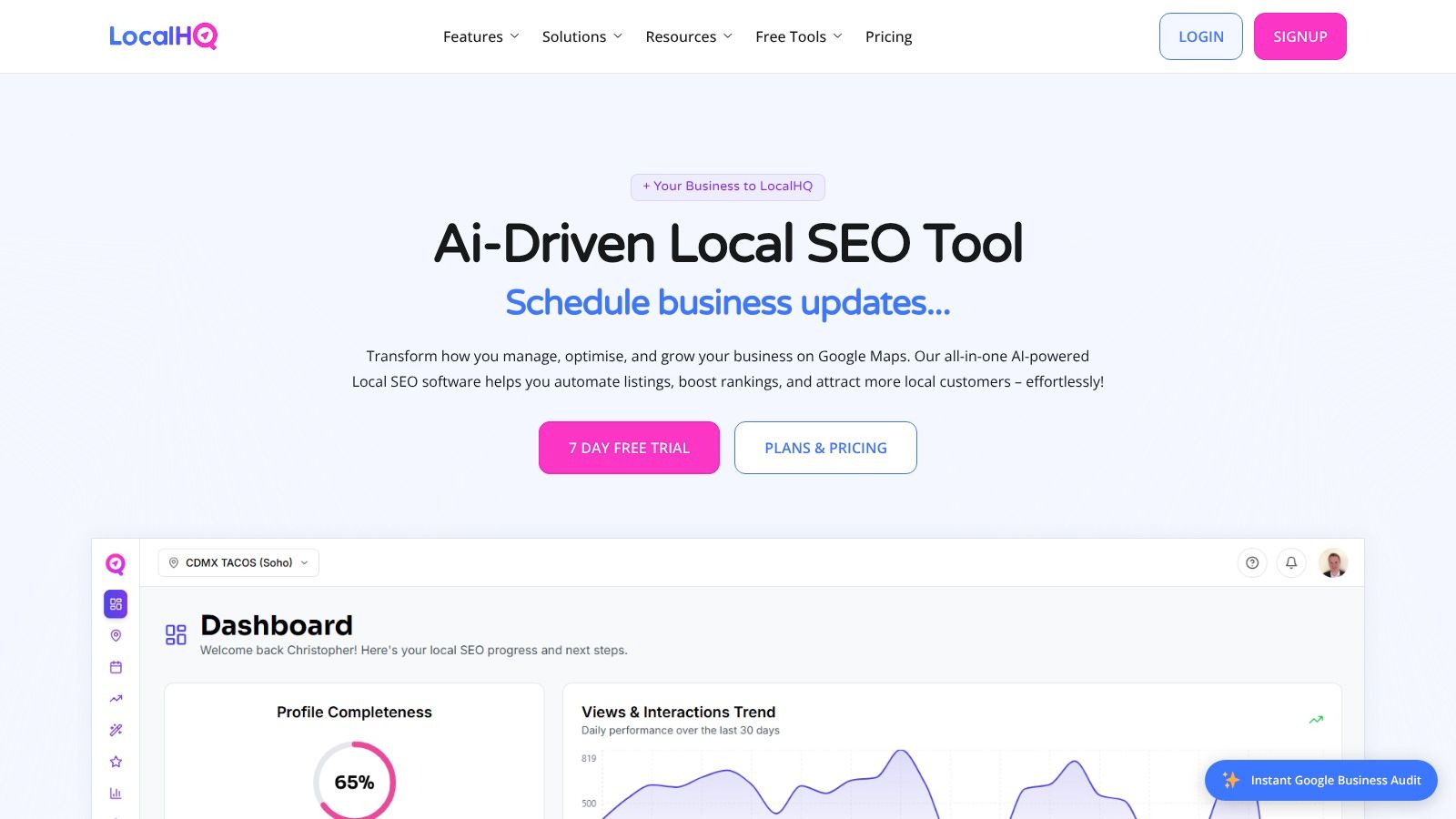
If your agency sells local visibility, LocalHQ is one of the clearest platform-led options on this list. It isn't trying to be every SEO tool at once. It focuses on the work that matters most for Google Business Profile, Maps visibility, reviews, location content signals, and client-ready reporting.
That focus is exactly why it works for agencies. You can manage one listing or dozens from a single dashboard, schedule posts, upload images and videos, monitor location performance, and produce white-label reports without stitching together five separate tools. For local-first agencies, that removes a lot of admin drag.
Why it stands out for agencies
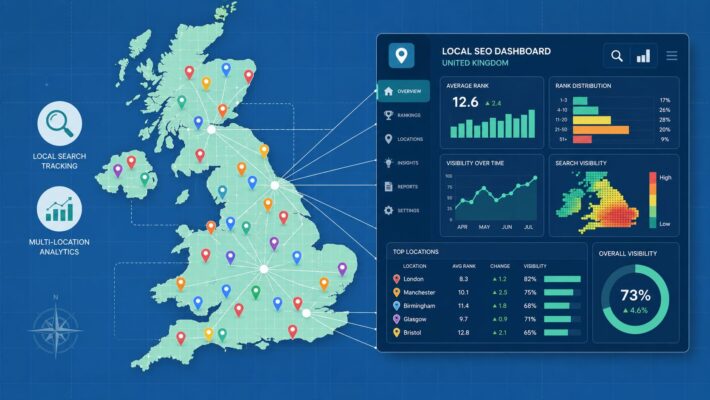
LocalHQ is built around practical local SEO workflows. The AI Optimisation Wizard suggests category, keyword, and profile improvements based on your own listing and nearby competitors. The Review Autoresponder helps you keep responses moving without turning reputation management into a daily manual task. The geo-grid rank tracker makes local visibility easy to explain to clients because they can see where they rank across actual service areas, not just in a flat keyword report.
Transparent pricing helps too. Plans start at £29 per month for one listing, then £49 per month for 2 to 9 listings, and £119 per month for 10 to 29 listings. Enterprise pricing is custom, and there's a 7-day free trial.
Practical rule: If most of your client results depend on Google Maps and GBP actions, pick a platform that makes those tasks faster every week, not just prettier in a monthly report.
LocalHQ also includes built-in citation ordering, a GBP auditor, and white-label reporting. If listings accuracy is part of your service mix, its professional local SEO listing management is a sensible add-on rather than a separate vendor relationship.
The trade-off
This is not a full replacement for broad technical SEO software. If your agency needs deep site crawling, enterprise content workflows, or large-scale backlink prospecting, you'll still want other tools in the stack.
Some advanced modules are still rolling out as well, so agencies wanting an all-in-one enterprise suite may find parts of the roadmap still catching up. But for local SEO delivery under your own brand, it's one of the strongest operational fits on this list.
Best for: UK agencies focused on local SEO, franchises, hospitality, retail, service-area businesses, and multi-location reporting.
2. FATJOE
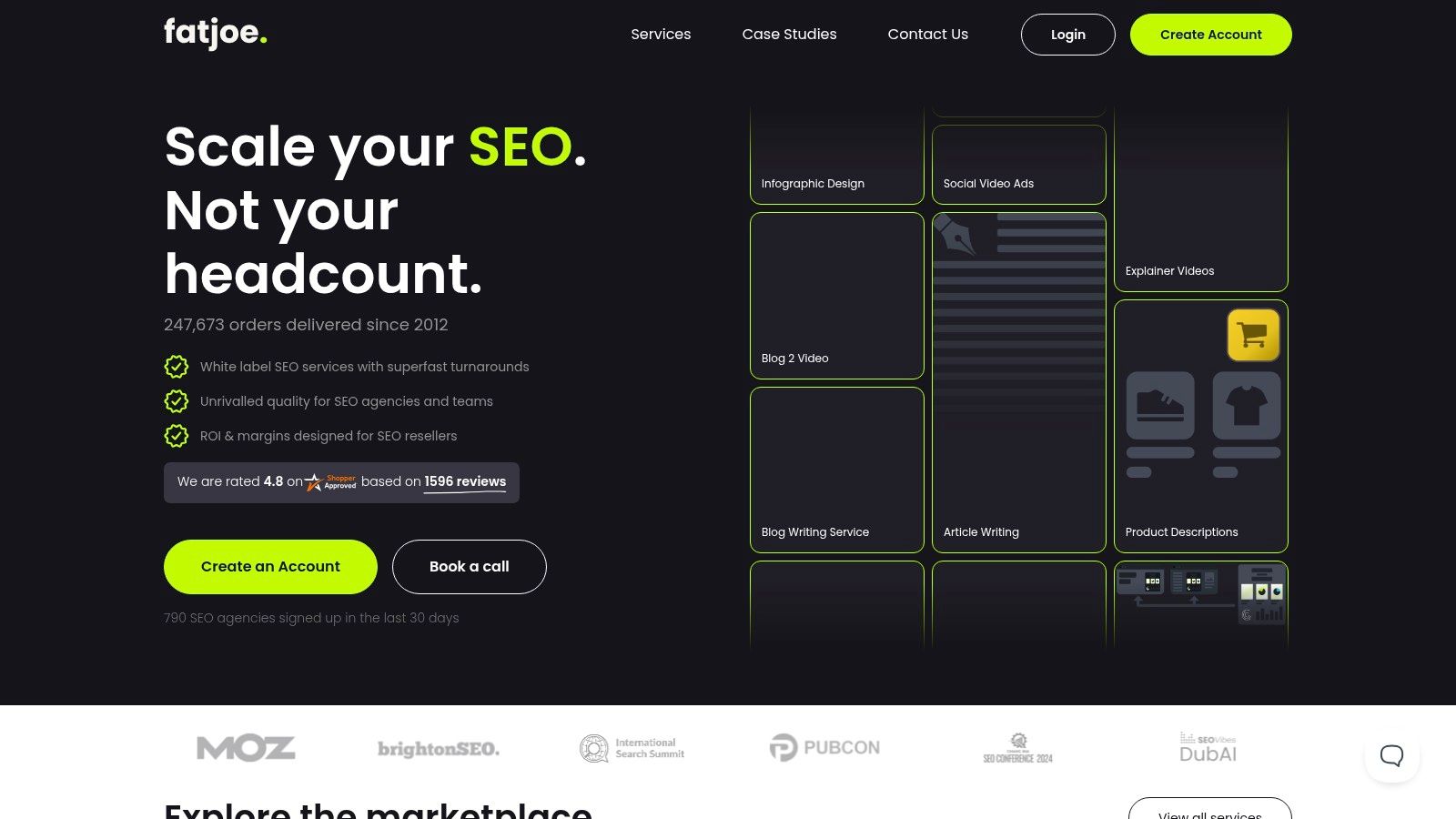
FATJOE works well when you don't need a strategic platform. You need output. Fast. It's a productised fulfilment partner with a menu of services agencies can resell, especially link building, content writing, digital PR, and local citation work.
The biggest advantage is operational simplicity. You can order defined deliverables, track them in a reseller-friendly workspace, and send unbranded reports to clients without rewriting everything from scratch. Agencies that sell repeatable SEO packages usually get on well with this model.
Where FATJOE fits
FATJOE is strongest when your team already owns strategy and client communication, but needs reliable production support. That's common in agencies that have a capable account manager or strategist but don't want an in-house team handling outreach, article writing, or citation fulfilment.
It also helps that the company is UK-based and has been operating since 2012, with a 4.8 out of 5 Trustpilot rating noted in this review. I wouldn't use a review score alone to choose a partner, but it does support the idea that they've built a mature delivery process.
- What works well: Transparent, menu-style ordering and predictable turnaround windows.
- What to watch: Pre-approval on blogger outreach isn't standard, so your team needs to review placements after delivery.
- What agencies sometimes miss: Domain metrics don't always equal niche fit. You still need a human review layer.
FATJOE is not the partner I'd choose for highly bespoke SEO strategy. It is a solid fit for agencies that want fulfilment they can package, mark up, and move through a repeatable workflow.
Best for: Agencies reselling content, outreach, digital PR, and local citations at scale.
3. Click Intelligence
Click Intelligence sits in the middle ground between a service partner and a more structured reseller operation. If you want a broad SEO menu, UK positioning, and a branded reporting environment, it's worth serious consideration.
A lot of agencies choose white label partners based on a single service line, usually links or content. Click Intelligence is better suited to shops that want one partner covering several categories, including SEO, link building, content, digital PR, and PPC.
Practical fit
Its Click Insights reporting layer is one of the more useful agency-facing features. Being able to host analytics and reporting in a brandable environment matters more than people think. It reduces the 'who did this work?' problem and makes your offer feel more like a retained service than a stitched-together vendor stack.
The other strength is breadth. If your clients move from local SEO into technical remediation, international work, or PR-led authority building, there's enough range here to keep fulfilment under one roof.
A broad service menu is useful only if your team still controls quality. More SKUs can hide weak review processes.
The main trade-off is that custom work usually means custom pricing. That's normal at this end of the market, but it does make margin planning less straightforward than with pure productised vendors. Some packaged services can also feel a bit less flexible than a fully bespoke outreach campaign.
Best for: Agencies that want UK-based positioning, white-label reporting, and a wider specialist menu than a simple link vendor can offer.
4. BrightLocal Citation Builder

BrightLocal's Citation Builder is not a full white label SEO programme on its own. It's a specialised local SEO fulfilment layer. That distinction matters, because agencies often overbuy all-in-one services when they really just need citation building and clean-up handled properly.
For local campaigns, especially in service businesses and multi-site retail, that specialisation is useful. Citation work is repetitive, easy to bottleneck internally, and annoying to QA. BrightLocal gives agencies a cleaner way to outsource it while keeping reporting tied into a local SEO stack.
Why agencies keep using it
The pay-as-you-go structure is appealing because it makes margins easier to calculate. You're not committing to a large monthly fulfilment arrangement just to get listings built or corrected. It's also useful if your agency handles local strategy in-house but wants fulfilment support on the directory side.
The white-label reporting options and broader BrightLocal ecosystem add context here. If your reporting, rank tracking, and listings work already live in one place, account management becomes easier.
For agencies managing complex branch networks, it's worth comparing specialised citation fulfilment with broader top 12 SEO tools for multi-location businesses before locking in a workflow.
- Strong point: Transparent per-citation costing.
- Limitation: Citation work is foundational, not a complete SEO strategy.
- Margin risk: Heavy usage across many locations can add up faster than flat-bundle fulfilment.
BrightLocal is best when you want a dependable local listings engine, not a strategic SEO partner.
Best for: Agencies handling local SEO in-house that need scalable citation building, clean-up, and reporting support.
5. Rhino Rank
Rhino Rank is a focused link fulfilment partner. It's strongest when your agency already has the strategy sorted and needs placements delivered through a cleaner, productised process.
That narrow focus is a strength, not a weakness, if link acquisition is the actual bottleneck in your operation. Guest posts and niche edits are the core offer, with white-label reports and a self-serve portal that keeps account handling fairly light.
Where it works best
Some agencies don't want full-service SEO fulfilment because they lose too much control. Rhino Rank suits teams that want to keep technical work, content strategy, and reporting in-house while outsourcing only link acquisition.
Its UK team also makes the service easier to position for British agencies and clients, especially where localisation and communication style matter. The in-house content angle helps with contextual placement, which is important if you're trying to avoid links that look bolted on.
If a provider only handles links, that can actually improve quality control. You know exactly what they're there to do.
The downside is obvious. This is not end-to-end fulfilment. If a client needs technical clean-up, GBP work, or content production beyond placement support, you'll still need other partners or internal capacity. Pre-approval transparency may also vary depending on the service tier, so agencies that want very tight placement control should check the workflow before selling it hard.
Best for: Agencies that need scalable guest posts and niche edits without outsourcing their whole SEO function.
6. The HOTH
The HOTH is one of the larger reseller ecosystems in this category. If your agency wants a huge catalogue of packaged services, partner training, wholesale access, and a central dashboard, it's designed for that use case.
For small agencies trying to launch SEO without building processes from scratch, that structure can be very helpful. There's enough sales enablement and product variety to create offers quickly, especially if you prefer selling standardised packages.
The real trade-off
Breadth creates convenience, but it also creates inconsistency risk. Different service lines can perform very differently, so the smart way to use The HOTH is to be selective. Treat it like a product catalogue, not a blind outsource-all arrangement.
That matters even more for UK agencies because fulfilment cadence, writing style, and reporting expectations can differ when the provider is US-based. It's not a deal breaker, but it is something to plan around.
Their reseller setup does include white-label deliverables and a central dashboard, which helps if you want your own client-facing layer. If local visibility is a major part of your service mix, I'd pair broad fulfilment with a dedicated tool such as LocalHQ rank tracking software so you're not relying only on generic ranking snapshots.
- Best part: Very broad range of services to bundle.
- Weak point: Real pricing often becomes clear only after sign-up or consultation.
- Agency advice: Test a few SKUs before committing to a full delivery model.
Best for: Agencies wanting a wide reseller catalogue and structured onboarding rather than a niche specialist.
7. Boostability
Boostability is built for agency volume, particularly SMB campaigns that need a repeatable sales and launch process. That makes it less exciting on paper than some boutique providers, but often more practical for agencies that need consistency.
The partner model includes dedicated growth support, white-label dashboards, and sales collateral. That's useful if your team can sell SEO but needs help standardising proposals, onboarding, and campaign flow.
When Boostability makes sense
This is a strong fit for agencies working with lots of smaller local businesses. You're not buying handcrafted strategy. You're buying an operating model that helps you sell and deliver standardised SEO repeatedly.
That matters in the UK market because agency use of white label partnerships is already common. A UK-specific survey of 450 digital agencies found that 68% use white label SEO partnerships, which lines up with what many agency owners are seeing on the ground. The need isn't theoretical. Teams want delivery capacity without hiring every specialist internally.
If your offer is heavily local, pairing a fulfilment partner with a purpose-built LocalHQ local SEO dashboard can give your clients a stronger reporting and GBP management experience than a generic monthly PDF alone.
Boostability becomes less attractive when campaigns are highly bespoke or technically complex. Its strengths are process, volume, and repeatability, not unusual edge-case SEO builds.
Best for: Agencies selling standard local and SMB SEO campaigns at volume.
8. SEOReseller.com
SEOReseller.com is designed for agencies that want fixed packages they can sell repeatedly with minimal reinvention. If your sales process depends on clear tiers and predictable deliverables, that packaging can save time.
The service structure is one of its main selling points. Plus, Premium, and Prime style packages are easier for account managers to explain than a long list of modular fulfilment tasks. For some agencies, that simplicity is exactly what helps them close.
What to like and what to question
The platform bundles technical, on-page, outreach, dashboards, and local add-ons into resellable programmes. That creates consistency in scoping, which is useful if your team struggles with custom quoting or scope creep.
It can also become limiting. Competitive niches, unusual site structures, and mixed local-national campaigns don't always fit neatly into package logic. That doesn't mean the service is poor. It means the model favours standardisation.
A provider like this tends to work better when your own agency messaging is also package-driven. If your local SEO offer needs stronger reporting logic and clearer business outcome framing, LocalHQ's framework for local search ROI is a useful complement.
Package-led fulfilment works best when your agency has already decided what “good enough standardisation” looks like.
Exact pricing often sits behind account access or a consultation step, so margin modelling may take a little more work upfront.
Best for: Agencies that want fixed monthly SEO packages rather than a highly bespoke fulfilment relationship.
9. Semify

Semify tends to appeal to agencies that care about process maturity. It offers full-service white-label SEO, local Map Pack fulfilment, branded dashboards, and API options, so it can plug into a more established agency stack.
That makes it more operationally interesting than some purely packaged vendors. If your team already has CRM, onboarding, and reporting systems in place, API access and integration options matter because they reduce manual handoffs.
Agency perspective
Semify is a sensible partner when you want reliability over novelty. Month-to-month scalability, a dedicated account structure, and a broad service set make it easier to support mixed client portfolios.
The caution for UK agencies is mostly logistical. It's a US-based team, so communication rhythms and turnaround expectations should be nailed down early. If your clients expect same-day revisions or highly localised language, process alignment matters a lot.
Another useful lens is satisfaction and tool access. A 2025 Statista report cited in this industry summary says UK agencies using white label SEO programmes report 91% satisfaction, with 76% naming access to advanced technical resources as a key factor. That's the kind of advantage a provider like Semify is trying to deliver: systems and specialist capability your agency doesn't have to build alone.
Best for: Agencies that want mature fulfilment processes, integration options, and a scalable full-service backend.
10. Loganix
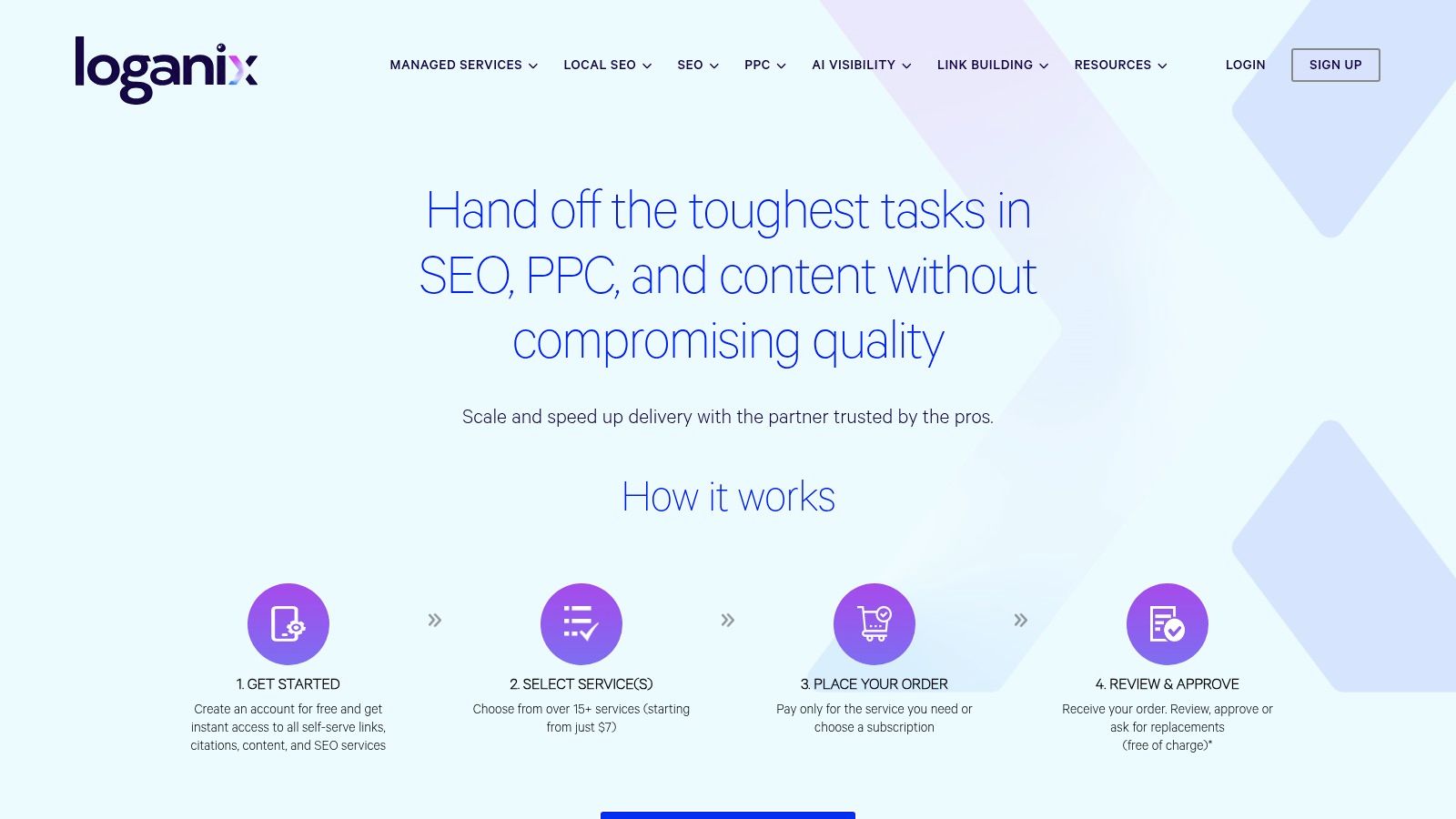
Loganix is agency-first in a very practical way. Its marketplace gives you access to discrete services such as citation building, clean-up, audits, content, and link placements without forcing everything into a monthly managed programme.
That flexibility is useful if your agency has mixed delivery needs. Some clients need a one-off local clean-up. Others need regular links or content support. Loganix lets you buy at the SKU level without pretending every account needs the same stack.
Where Loganix earns its place
The local SEO catalogue is particularly useful for agencies serving location-based businesses. Citation build, audit, and clean-up options give you a straightforward way to support foundational local work at scale, while branded Looker Studio reporting helps preserve your agency front.
The trade-off is price discipline. Premium placements can get expensive, and agencies sometimes forget that “good vendor margin” still has to become “good client margin” after account management time is added in. Some services are also clearly on-demand rather than extensively bespoke, so unusual campaigns may need extra scoping.
Still, there's a lot to like if you want a self-serve marketplace combined with a partner-friendly approach. Loganix is one of the easier vendors to slot into an existing agency operation without redesigning your whole offer.
Best for: Agencies that want flexible local SEO and link-building SKUs with white-label reporting support.
Top 10 White-Label SEO Programs Comparison
| Product | Core features | Rating ★ | Price/Value 💰 | Target audience 👥 | Unique selling points ✨ |
|---|---|---|---|---|---|
| LocalHQ 🏆 | AI Optimisation Wizard, GBP sync, scheduled posts, Review Autoresponder, geo-grid tracker, white‑label reporting | ★★★★★ | 💰 Single £29/mo · Multiple £49/mo · Agency £119/mo · 7‑day trial | 👥 SMBs, multi‑location brands, franchises, agencies | ✨ AI-driven local optimisation + geo-grid visibility + 24/7 review automation |
| FATJOE | Blogger outreach, niche edits, citations, white‑label reseller workspace | ★★★★ | 💰 Menu pricing; predictable SKUs & guarantees | 👥 Agencies reselling link/content SKUs | ✨ Productised link building with unbranded reports |
| Click Intelligence | White‑label SEO & link building, ordering portal, Click Insights (brandable reporting) | ★★★★ | 💰 Quote/custom pricing for many packages | 👥 UK agencies/resellers | ✨ Awarded UK team + brandable analytics portal |
| BrightLocal (Citation Builder) | Per‑citation campaigns, clean‑up, white‑label reporting, integrates with rank tracking | ★★★★ | 💰 Pay‑as‑you‑go per citation; bulk discounts | 👥 Agencies doing local listings at scale | ✨ Transparent per‑citation costing + broad directory coverage |
| Rhino Rank | Niche edits & guest posts, white‑label reports, order/dashboard portal | ★★★★ | 💰 Productised pricing; self‑serve ordering | 👥 Agencies preferring insertion‑style links | ✨ Fast, scalable curated link placements |
| The HOTH | Wide service catalogue (managed SEO, links, citations), reseller programme, dashboard | ★★★ | 💰 Wholesale/partner pricing (consultation) | 👥 Agencies wanting many packaged SKUs | ✨ Extensive SKUs + reseller training & credits |
| Boostability | Partner Growth Managers, white‑label dashboards, sales enablement & playbooks | ★★★ | 💰 Partner pricing via onboarding | 👥 SMB‑focused resellers scaling many campaigns | ✨ Dedicated partner managers + repeatable SMB workflows |
| SEOReseller.com | Pre‑packaged monthly programs, white‑label live dashboards, local add‑ons | ★★★ | 💰 Tiered package pricing (signup/quote) | 👥 Agencies that prefer consistent monthly packages | ✨ Clear tiered scopes for easy reselling |
| Semify | Full‑service white‑label SEO, branded dashboards, API & SLA‑driven delivery | ★★★★ | 💰 Packages/quotes after consultation | 👥 Agencies needing integrations & reliable SLAs | ✨ API integrations + SLA-focused fulfilment |
| Loganix | Link building, citation build/cleanup, audits, branded Looker Studio reporting, marketplace | ★★★★ | 💰 Per‑SKU pricing; replacements & partner programme | 👥 Agencies needing vetted placements & local SEO | ✨ Vetted placements + branded reporting dashboards |
How to Choose the Right White-Label SEO Programme
Most agencies don't need more options. They need fewer bad fits. Choosing between white label seo programs gets easier once you stop treating every provider as if it solves the same problem.
Start with the biggest distinction. Do you need software, fulfilment, or both? Platforms like LocalHQ help your team execute local SEO faster and present it cleanly under your own brand. Fulfilment partners like FATJOE, The HOTH, or Semify handle production work your team doesn't want to build internally.
Match the model to the bottleneck
If your team is strong on strategy but weak on capacity, a fulfilment partner usually makes more sense. If your agency already knows local SEO well and mainly needs better workflows, reporting, and automation, a platform-first option is often the better investment.
That distinction matters more in the UK than some agencies realise. The digital marketing consultancy sector is projected to keep growing, and teams are under pressure to scale without overhiring. The challenge isn't whether outsourced delivery exists. It's whether the operating model fits the way your agency works.
- Pick software first if your problem is workflow inefficiency, local reporting, or multi-location admin.
- Pick fulfilment first if your problem is production capacity across links, content, audits, or standard SEO tasks.
- Pick both if you want outsourced execution but still need a stronger client-facing reporting layer.
Check what “white label” really means
Some providers say white label when they mean “we won't put our logo on the PDF”. That's not enough. You need to know what the client sees, what your account managers see, and whether the reporting experience strengthens or weakens your brand.
Look closely at dashboards, branded exports, domain customisation, and communication boundaries. If a client-facing environment still feels like someone else's software, it chips away at perceived authority.
A white-label partner should disappear operationally but improve your service commercially.
Judge quality by review friction
The best test is simple. How much work does your team have to do before a deliverable is safe to send? Every provider requires some review. The difference is whether that review is strategic polish or emergency repair.
For link vendors, inspect sample placements. For local SEO tools, inspect reporting clarity and ease of use. For full-service partners, ask how they handle revisions, lost links, escalation, and account management. If the answers are vague, the relationship will get expensive in hidden labour.
The market has clear demand for these models, but UK-specific hard data remains patchy in places. One verified summary notes that there's still a real gap in UK-only benchmarks for white label SEO adoption and ROI, even though agencies widely use these arrangements and local SEO remains a core need for service businesses and multi-location brands.
The safe approach is practical rather than theoretical. Choose the partner that reduces delivery friction, protects your margins, and fits the kind of clients you already serve.
For agencies that sell local SEO, that usually means putting reporting, Google Business Profile management, review handling, and location visibility tracking at the centre of the offer. If that's your growth lane, Magnitude Marketing's AI-first SEO is also a useful reminder that execution matters most when it connects directly to a modern search workflow.
If local SEO is where your agency wins, LocalHQ is the most practical place to start. You can manage Google Business Profiles, automate review responses, track visibility with geo-grid reporting, and deliver white-label insights clients understand, all from one dashboard.