



What should local AI visibility metrics tell you?
Local AI visibility metrics should show whether an AI answer names the right business, supports the answer with useful sources and gives accurate information for the location being checked. Website visits and enquiries belong alongside those observations, but they need their own evidence. An answer mentioning your business is not proof that someone visited or contacted you.
Start with the decision you need to make. A single-location owner might need to know whether answers describe their service correctly. An agency might need a consistent way to compare the same client locations over time. Neither task is solved by a percentage without its underlying questions, dates and counts.
This guide provides a recording method and a downloadable worksheet. It complements the local AEO and GEO checklist, which covers improvement tasks, and the AI Visibility Audit feature page, which explains LocalHQ’s proposition. The measurement conventions below are an editorial framework, not a claim about a particular product’s scoring system.
Six measurements worth keeping separate
Write down your definitions before the first check. Vendors can use similar labels for different calculations: Semrush, for example, documents its own definitions of mentions and citations. Read the methodology of any tool you use rather than assuming its score matches your worksheet.
| Measurement | Our recording convention | What it helps you decide |
|---|---|---|
| Business mention rate | Valid answers naming the correct business ÷ valid answers checked × 100. | Whether your business appears across your chosen customer questions. |
| Own-site citation rate | Valid answers visibly linking to your website as a supporting source ÷ valid answers checked × 100. | Whether your own pages are used as visible sources in this sample. |
| Explicit recommendation rate | Valid answers explicitly presenting your business as a suitable option ÷ valid answers checked × 100. | Whether the answer goes beyond naming the business. Define what counts as a recommendation. |
| Checked fact accuracy | Correct facts ÷ facts you could verify against authoritative business records × 100. | Which address, service, opening-hour or contact errors need attention. Record unresolved facts separately. |
| Identifiable AI referral sessions | Website sessions with an identifiable AI referral source under your analytics rules. | What identifiable visits do after arriving, within the limits of your collection and attribution. |
| Relevant outcomes | Verified enquiries, bookings or other meaningful actions, using your existing measurement definitions. | Whether the activity supports the business, without treating every outcome as AI-driven. |
A mention should identify the intended business, not another firm with a similar name. A citation to a directory discussing your business is different from a citation to your own website: record the source URL and its type. A link alone does not establish that the linked page supports the whole answer.
For recommendation checks, keep the exact sentence or a short evidence note. “Businesses in the area include…” may be a list rather than an endorsement. Apply your agreed rule consistently, and mark ambiguous cases for review instead of silently counting them as wins.
Build a small, repeatable question panel
Choose questions a prospective customer could reasonably ask before selecting your service. Include the service, place and a genuine suitability condition. For a fictional plumber, a question might be “Which plumbers serve this part of Bristol for an urgent leak?” That example does not imply any particular business offers emergency work.
- Separate discovery from brand checks. “Which businesses provide this service here?” tests a different task from “What are this named business’s opening hours?” Keep these groups separate in your reporting.
- Fix the scope. Record the branch or service area, language, engine and product surface. A conversation in one assistant and a Google search feature are different observations.
- Keep the conditions visible. Note the date, exact prompt, relevant session context and any location setting you can actually verify. Do not assume typing a town name establishes the system’s detected location.
- Repeat the same panel. Use a consistent collection method and retain earlier evidence. When you add or remove questions, report that as a panel change and keep a comparable subset.
There is no universal number of prompts that makes a local score representative of all customers. Start with a manageable panel covering your important services and questions. Explain its coverage rather than presenting a hand-picked sample as total market visibility.
Record unsuccessful attempts too. A timeout, access error or unavailable AI answer is not the same as a valid answer that omitted your business. In this framework, unsuccessful attempts stay outside answer-rate denominators and are reported as a separate count. A valid answer that names no businesses still belongs in the valid-answer denominator.
Download the local AI visibility recording worksheet
Download the Blank CSV Worksheet
The worksheet opens in common spreadsheet software. Use one row per observation and retain links to the supporting evidence. It contains fields for the prompt group, business/location, question, engine/surface, date, outcome, mention, own-site citation, source URL, recommendation decision, checked facts and next action.
A workable coding rule: use Yes, No or Review for the qualitative checks, and Valid, Unavailable or Error for the observation status. Resolve Review cases before calculating that metric, or disclose their separate denominator. Use blank or Not checked for facts you did not investigate; do not turn an unknown into a zero.
Keep the raw evidence and the summary apart. The worksheet records observations; a separate summary calculates rates for a specified panel, location, engine and period. Analytics sessions should come from your analytics report, not from counting rows in this file. Store evidence appropriately and avoid including customers’ personal information in test prompts or screenshots.
For each repeated check, ask whether the same definition and denominator were used. If someone changes “citation” from any supporting source to your own website only, the resulting percentages are different metrics. Rename the series or recalculate comparable historical records rather than drawing a trend line through both.
A worked example: read the counts before the percentage
These percentages do not establish whether the business is performing well. The commercial importance of the questions matters. One incorrect phone number could deserve more urgent attention than several missing mentions for marginal services. Equally, a higher mention rate after adding easier branded questions would not establish improvement in unbranded discovery.
With only 36 valid answers, a single additional mentioned answer changes the mention rate by about 2.8 percentage points. Show the counts and question mix alongside small movements. Repeated answers can share underlying sources and conditions; do not assume they are independent observations or claim statistical significance without a suitable analysis.
Why AI answers and website traffic need separate evidence
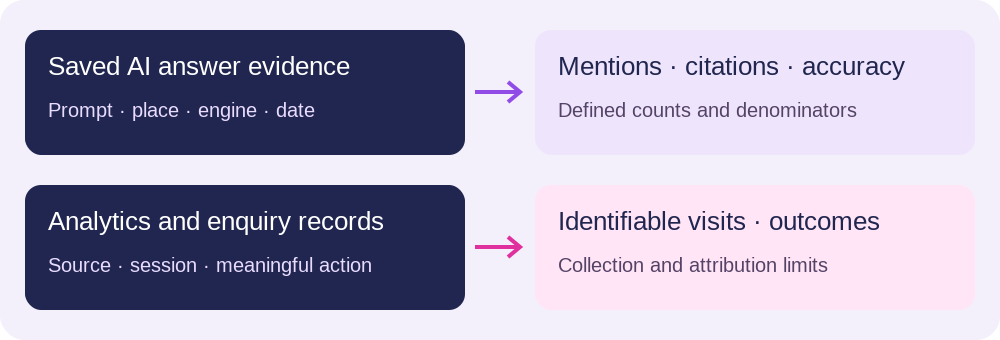
Google Analytics’ Traffic acquisition report describes where sessions come from, using session-level source dimensions. It is a useful starting point for inspecting identifiable referrals and the actions associated with those visits. It is not a census of everybody who saw an AI answer about your business.
Someone may read an answer without clicking, follow a route that does not preserve an identifiable referrer, or contact the business another way. Your collection settings and consent choices also affect what can be observed. Keep the label precise: “identifiable AI referral sessions” is more defensible than “all traffic generated by AI”.
Use your existing enquiry and booking definitions and check whether meaningful actions are actually recorded. A rise in AI mentions alongside more enquiries is an observation worth investigating, not proof of causation. Keep wider local SEO reporting and business outcomes visible so the team can assess the whole customer journey.
For the practical acquisition check, use the GA4 AI referral validation checklist to inspect current channels, source values and recorded actions.
Turn a measurement into an assigned next step
| Finding | Useful next action | Check again against |
|---|---|---|
| The wrong branch or telephone number appears. | Identify the cited source where available; check authoritative business information and correct inconsistencies you control. | The same factual question and location, with saved evidence. |
| A service is mentioned, but its coverage is unclear. | Clarify the real service area and suitability information on the relevant existing page. | The same service-and-place question, without changing the test halfway through. |
| Your own page is cited but does not answer the customer’s question well. | Review the cited page for accuracy, completeness and a useful route to the next step. | The page itself, subsequent comparable observations and relevant visit outcomes. |
| Percentages rise after the prompt panel changes. | Separate the old and new panels and compare only the retained questions. | Like-for-like counts, not the combined headline score. |
Assign an owner, record the change and set a review date. The guide to local search AI ranking factors helps assess the wider evidence and priorities; this worksheet provides a more specific way to record what your checks actually found.
Questions about measuring local AI visibility
What is a good AI visibility score?
There is no universal threshold across engines, products, locations and question panels. Read the provider’s definition, then assess your own important questions, accurate business information and relevant outcomes. Compare like-for-like samples over time rather than borrowing another business’s percentage as a target.
Is an AI citation the same as a business recommendation?
No. A citation points to a source; a recommendation presents a business as an option. An answer can cite a page without recommending its owner, or name a business while citing a third-party source. Record each observation separately.
Can I combine every engine into one visibility percentage?
You can define a combined measure, but first report each engine and the number of valid answers separately. Otherwise an engine with more observations dominates the result. State any weighting rule, preserve the underlying counts and avoid implying that your chosen weighting represents real customer usage.
Does the worksheet require a LocalHQ subscription?
No. It is a blank editorial recording template. To assess the platform workflow for your business, explore LocalHQ’s local AI search solution and confirm the current audit coverage and access for your requirements in a demo.
Ready to present the observations to a client? Use the AI search reporting template and action register to explain comparison limits, request approvals and assign the next steps.
Sources and next steps
This measurement framework was prepared by LocalHQ. Product terminology and analytics descriptions were checked against the primary documentation below on 4 November 2026. The example is fictional, and the worksheet is not an export from a live product.
- Semrush: AI visibility metric definitions — an example of provider-specific terminology.
- Google Analytics: Traffic acquisition report — session-level traffic source reporting.
- Google Search: AI features and your website — search eligibility and website guidance.
Choose one location and a small set of important questions, agree the coding rules, then record the first baseline. Return to the AI Search Hub for related guides as the work develops.