Master Local Search AI Ranking Factors for 2026
Most local businesses still treat AI search like a future problem. It isn’t. The uncomfortable reality is that winning visibility in AI-driven local discovery is already far harder than winning a place in traditional local results.
Research cited by SOCi says AI local visibility is up to 30 times harder to achieve than traditional local search visibility, and in its 2026 Local Visibility Index only 1.2% of locations were recommended by ChatGPT compared with 35.9% appearing in Google’s local 3-pack (SOCi’s analysis of AI and local SEO). That gap should change how any business owner thinks about local SEO. The old playbook still matters, but it no longer tells the whole story.
If you run a restaurant, dental clinic, law firm, plumber, salon, or retail chain, Local search AI ranking factors now shape whether search engines and AI assistants see you as a safe, relevant recommendation. That judgement is built from your business profile, your website, your reviews, your consistency across the web, and the clarity of the signals you give Google.
The New Reality of Local Search Visibility
Local visibility now depends less on whether you mention the right phrase and more on whether Google’s systems trust your business enough to recommend it.
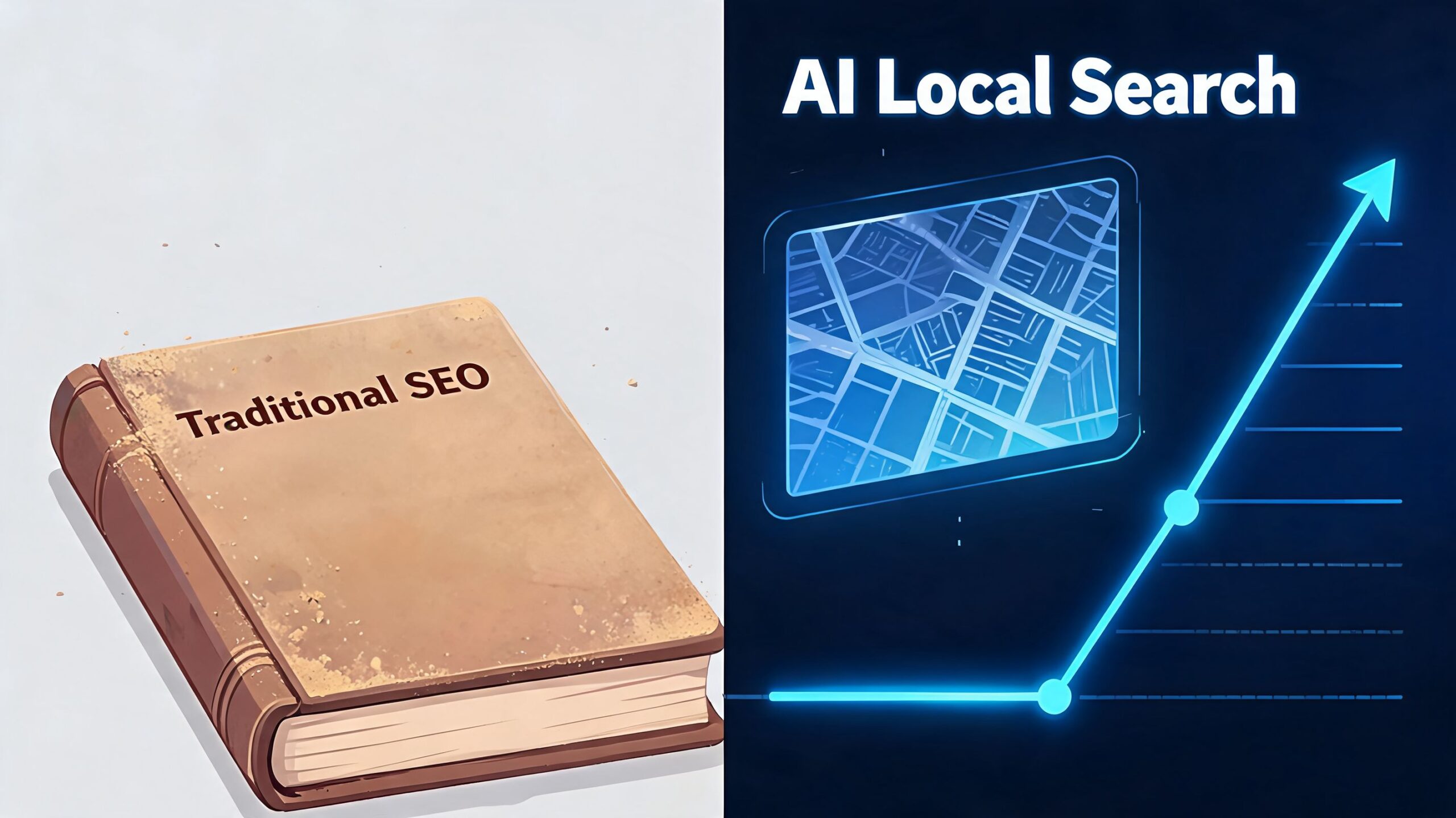
That changes the job. A tidy Google Business Profile, a few location pages, and a stream of reviews still help, but they no longer cover for weak signals elsewhere. If your categories are slightly off, your service pages are vague, or your review replies are generic, AI-driven search is more likely to pass over you in favour of a competitor with clearer evidence.
Why the old local SEO checklist is no longer enough
The old approach rewarded coverage. Fill out the profile. Add the town to the title tag. Build citations. Collect stars. Those tasks still belong on the list, but AI systems judge how well those pieces fit together.
The practical effect is that local SEO has become less forgiving. A plumbing firm with the right primary category, detailed emergency call-out information, and recent review responses sends a stronger signal than one with similar proximity but patchy business details. A dental clinic that explains treatments in plain English often outperforms one that relies on thin service pages stuffed with keywords.
This is the shift many owners feel without being able to name it. Search has moved from simple matching to confidence scoring.
A useful comparison is this. Traditional local SEO helped you appear eligible. AI-influenced local search decides whether your business looks recommendation-worthy. That is a higher bar, especially in UK markets where town-level competition is tight and service-area businesses often look interchangeable on the surface.
- Traditional local search: Often gave you some visibility if you were nearby and roughly relevant.
- AI-influenced local discovery: Puts more weight on consistent business data, specific service information, review sentiment, and signs of active management.
- Business impact: Small weaknesses now affect whether your business is surfaced as a trusted option at all.
Practical rule: If your profile, website, reviews, and citations describe the business differently, Google has less reason to treat you as a confident recommendation.
What local businesses should take from this
For a smart overview of how local firms are adapting, ZenChange Marketing on local business growth connects AI visibility to the day-to-day reality trades and service businesses face.
The priority is to manage local SEO as a signal system, not a box-ticking exercise. Your Google Business Profile category choices, your review responses, your opening hours, your service pages, and your mentions across directories should all reinforce the same story. When they do, Google gets a cleaner picture of who you serve, where you operate, and why you are a safe option to show.
That is also why a grounding in local search optimisation fundamentals still matters. The basics have not gone away. The standard for executing them has become stricter. Tools such as LocalHQ help by keeping those signals aligned at scale, which is often the difference between looking active and looking neglected.
Understanding Google's Local AI Engines
Most business owners don’t need a computer science lesson. They need a working model of how Google interprets local intent. The easiest way to understand that model is to think less about algorithms and more about roles.
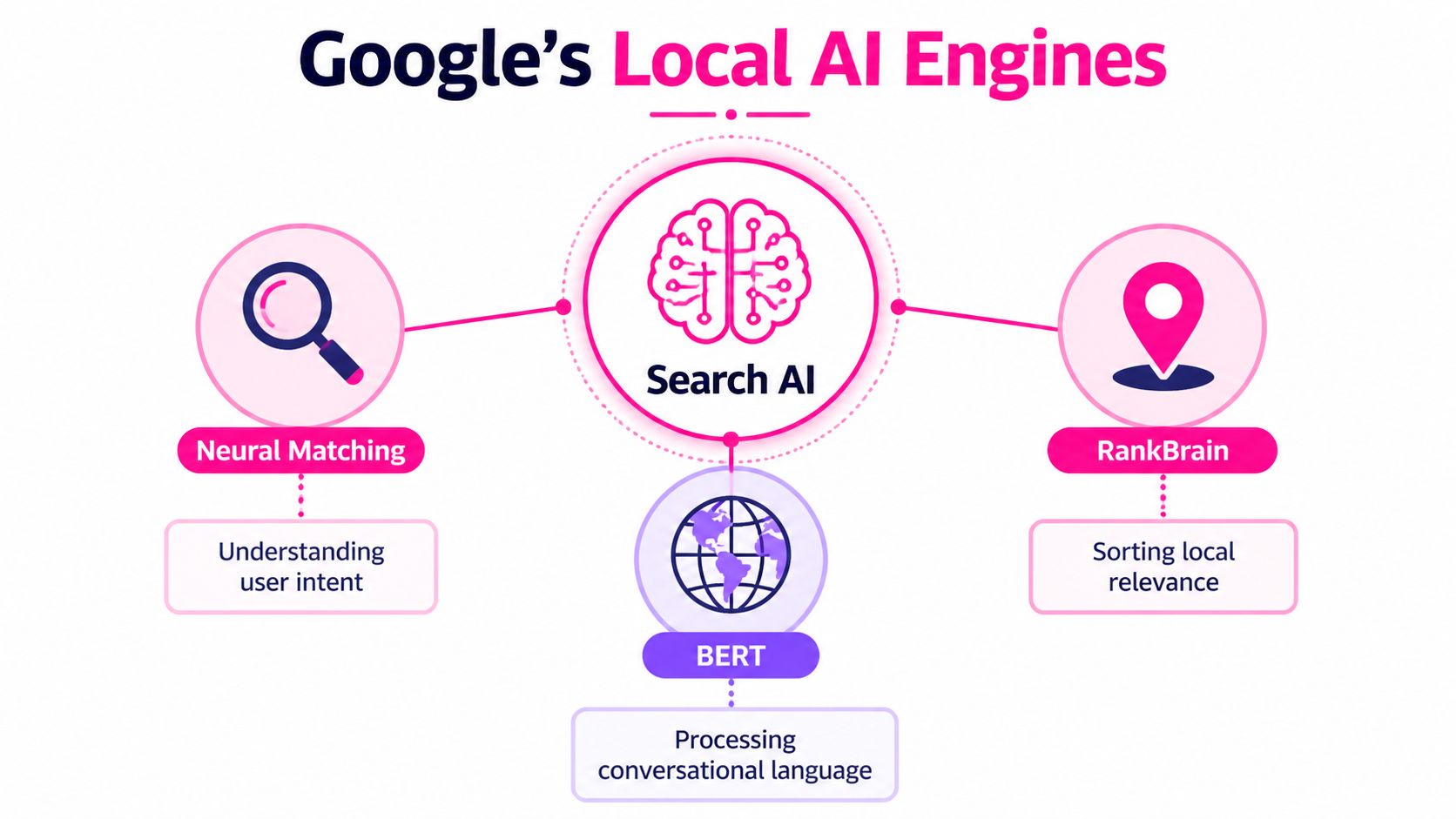
One system acts like an interpreter. Another behaves more like a concept matcher. Another helps process natural language so Google can understand how people naturally speak, especially in longer and more conversational local searches.
RankBrain as the query interpreter
RankBrain is easiest to picture as the part of Google that tries to work out what the searcher means, not just what they typed. If someone searches for “best place for emergency tooth pain near me”, Google isn’t looking only for pages repeating that phrase. It’s trying to understand urgency, service type, likely intent, and local relevance.
That matters because businesses often over-focus on exact keywords. They create one page for every phrase variation and miss the bigger issue. Does the page clearly explain the treatment, availability, location, trust signals and next step?
If RankBrain-like systems are interpreting intent, pages that answer the underlying need tend to make more sense than pages built around awkward keyword repetition.
Neural Matching as the concept connector
Neural Matching does a different job. It helps Google connect related ideas even when the search and the business wording don’t line up perfectly. A user may search for “late night chemist”, while a business page says “pharmacy open evenings”. Google can bridge that gap if the surrounding context is strong enough.
This is one reason service pages, FAQs, attributes, categories and review language matter so much. They create context. Context helps the search engine understand that your business fits a need even when the wording varies.
Google’s local AI systems don’t just scan for matching phrases. They piece together meaning from your profile, your website, and the language customers use about you.
Why conversational search changes local optimisation
People search more naturally now. They ask full questions. They search by problem, urgency, comparison and suitability. A legal client might ask who handles landlord disputes nearby. A diner might ask which brunch spot is good for families. A patient might ask for a clinic open on Saturdays.
That shift explains why resources such as SEO strategies for real estate AI are useful even outside property. The sector is different, but the lesson is the same. Search engines are getting better at matching intent-rich questions to businesses that look contextually relevant and trustworthy.
This is also why understanding Google Business Profile ranking factors matters more than ever. Your primary category, secondary categories, services, business description, photos, review themes and opening hours all feed the machine’s understanding of what you do and when you’re relevant.
A simple mental model
Use this framework when reviewing your local presence:
| Search AI job | What it’s trying to understand | What your business must provide |
|---|---|---|
| Intent interpretation | What the customer really wants | Clear service pages, useful FAQs, accurate categories |
| Concept matching | Whether your wording fits the need | Rich descriptions, natural language, varied review topics |
| Trust assessment | Whether your business is safe to recommend | Strong reviews, active responses, consistent data |
If your online presence is thin, vague or contradictory, Google has to guess. Guesswork rarely helps rankings.
Key AI-Influenced Local Ranking Factors
AI has changed local ranking from a checklist exercise into an interpretation problem. Google still looks at familiar signals, but it now does a better job of connecting them to intent, quality and trust. Search Engine Land reports that AI Overviews now appear for a large share of local searches, which helps explain why vague profiles and thin location pages lose ground faster than they used to (Search Engine Land’s guide to AI and local search).
For a local business owner, the practical point is simple. Google is no longer just matching a category and a postcode. It is trying to decide whether your business is a credible answer to a specific question.
Your Google Business Profile shapes how AI understands the business
A Google Business Profile now works more like a live data source than a static listing. Primary category, secondary categories, services, opening hours, attributes, photos and business description all help Google form a view of what you offer.
Incorrect categories are a foundational error that makes all subsequent optimisation work harder. If a solicitor chooses a broad category but never clarifies the practice areas, or a restaurant leaves menu-related details vague, Google has less confidence in when to surface that business. The same applies to service-area businesses with patchy coverage information and multi-department businesses that blur distinct services into one profile.
This is one of the first areas I check in an audit, because the effect spreads across visibility, click-through and lead quality.
Reviews help AI judge relevance, not just reputation
Review strategy now has two jobs. It needs to build trust with people and give search systems richer language to work with.
Written reviews often contain the detail Google cannot get from a star rating alone. Customers mention punctuality, bedside manner, wheelchair access, pricing clarity, emergency response, vegan options, noise levels, or whether a team handled a difficult job calmly. Those specifics help AI connect your business to the kinds of searches that happen every day.
Responses matter as well. A business that replies consistently shows signs of active management, customer care and operational discipline. That does not mean every reply needs to be long. It means the profile should show recent, relevant engagement instead of silence. This is exactly the sort of routine LocalHQ can automate at scale for UK multi-location brands without letting tone or compliance slip.
A smaller set of detailed, believable reviews can be more useful than a larger profile filled with short, repetitive comments.
On-page content needs local substance
AI systems are harder to satisfy with placeholder copy. A location page with a town name swapped into the same template rarely answers the questions that drive local enquiries.
Useful pages reduce uncertainty. They explain what the service includes, where it is available, how booking works, what customers should prepare, and what makes one option different from another. For a dentist, that might be emergency appointments and payment options. For an estate agent, it might be coverage by area, valuation process and landlord services. For a trades business, it might be response times, call-out areas and whether weekend work is offered.
The quickest test is blunt. If the page would be unhelpful without Google traffic, it probably gives AI very little to work with.
For anyone comparing the broader environment, local SEO ranking factors offers a helpful external perspective on how the classic pillars still interact as AI changes weighting and interpretation.
User behaviour is feedback, not a shortcut
Clicks, calls, direction requests and on-site engagement still matter, but they are more useful as signals of fit than as isolated targets.
If people see the listing and do nothing, the offer may look weak or unclear. If they click through and leave quickly, the page may not answer the search properly. If they read reviews but hesitate, trust may be the issue. Those patterns do not give you a trick for ranking. They show where the customer journey breaks.
That is why local SEO work now needs tighter coordination between profile management, review handling and website content. AI exposes the gaps between them.
A practical priority order
When I assess a business for AI-readiness, I usually work through these areas first:
Category accuracy and profile completeness
The profile needs to reflect the actual service mix, trading hours, attributes and service areas with no guesswork left for Google.Review themes and response discipline
Look beyond average rating. Check whether recent reviews describe the services and qualities you want to be known for, and whether replies show active management.Useful local landing pages
Each page should answer the questions a customer in that area would ask before calling.Consistency across the wider web
Conflicting business details weaken trust and make entity understanding less reliable.Visibility by geography
Rankings are rarely uniform across a town or city, which is why Google Maps ranking factors matter in practical local SEO work.
The common thread is clarity. AI tends to reward businesses that make it easy to understand who they serve, what they do well, and why a local customer should choose them.
The UK Perspective on AI Local Search
UK businesses need to be careful with imported advice. A lot of local SEO content still assumes a US market, US search behaviour, and US compliance realities. That creates blind spots.

BrightLocal’s overview of the 2026 Local Search Ranking Factors survey notes that for AI search visibility, on-page signals were weighted at 24% and review signals at 16%, but there’s no UK-specific breakdown, leaving a gap in understanding how these signals perform in Britain, especially with stricter data privacy under UK GDPR versus the US (BrightLocal on local algorithm and ranking factors).
Why UK businesses can’t just copy US advice
Some advice travels well. Accurate data, strong reviews, relevant content and active profile management matter everywhere. But the details of execution don’t always transfer cleanly.
A UK healthcare provider, solicitor, estate agent or franchise operator often works under different customer expectations and tighter compliance constraints than a US equivalent. That affects how reviews are requested, how customer feedback is processed, what content can be published, and how personal data is used in marketing workflows.
The result is simple. You shouldn’t assume every tactic discussed in a US blog is suitable, lawful or effective in the UK.
The data gap changes how you should make decisions
The absence of UK-specific AI ranking breakdowns doesn’t mean you should wait. It means you should test more carefully and rely less on generic industry myth.
That usually means:
- Check geo-specific performance: A business may rank well in one part of a city and poorly in another.
- Review your compliance process: Especially if you use automation around customer feedback and sentiment analysis.
- Watch language differences: British search phrasing, service terms, and place-name usage can differ materially from US examples.
- Prioritise credibility signals: In sectors where trust is central, weak signals are costly.
UK local SEO now needs two disciplines at once. Better optimisation and better governance.
What that means in practice
For many UK firms, the smartest approach is conservative and consistent. Keep your business data clean. Publish helpful local pages. Encourage genuine reviews through compliant processes. Respond carefully. Track visibility geographically, not just nationally.
That approach won’t feel flashy, but it aligns with how AI systems assess trust. It also reduces the risk of building your strategy on advice that was written for another market altogether.
Practical Optimisation for the AI Era with LocalHQ
The most effective response to AI-driven local ranking factors isn’t more theory. It’s better execution. The businesses gaining ground are usually the ones that tighten operations around profile accuracy, review management, content quality and local visibility tracking.
Start with your business profile, not your homepage
Most local SEO problems show up in the profile before they show up on the website. Categories are wrong. Services are incomplete. Opening hours drift out of date. Photos are stale. Descriptions are generic.
Fix those first. They influence how Google interprets your relevance before the customer ever reaches your site.
A practical profile review should cover:
- Primary category choice: This has to reflect the core commercial service, not a vague umbrella term.
- Secondary categories: Use them to clarify adjacent services, not to chase every possible variation.
- Service completeness: Name what you offer using natural customer language.
- Operational accuracy: Hours, phone number, address details and service areas must be right.
- Freshness: Recent photos, posts and updates show active management.
Treat review responses as ranking work, not customer service admin
Review management gets delegated too casually. In AI local search, that’s a mistake. A response does more than acknowledge a customer. It reinforces service relevance, demonstrates accountability, and adds natural language context around the business.
That doesn’t mean every reply needs to be long. It does mean every reply should sound specific and human. “Thanks for your feedback” repeated across dozens of reviews doesn’t add much value. A better response references the actual service experience, resolves issues clearly, and reflects the tone of the brand.
Good responses usually do three jobs at once:
| Review situation | Weak response | Stronger response |
|---|---|---|
| Positive review | Generic thanks | Thanks that references the service or visit context |
| Negative review | Defensive language | Calm acknowledgement with a clear next step |
| Mixed review | Ignores the concern | Recognises both praise and friction points |
If a customer mentions emergency call-out speed, wheelchair access, gluten-free options, or helpful staff by name, your response should engage with that detail. That language helps search engines understand what your business is known for.
Upgrade local pages so they answer real decisions
The next step is your website. Many local pages fail because they describe the business instead of helping the customer choose. AI systems are better at spotting the difference.
A strong local service page should reduce uncertainty. That might mean covering who the service is for, common problems, what happens next, where you operate, and what makes the offer suitable for that location. FAQs help when they answer real objections rather than padded keyword variants.
Here’s a simple content test I use:
- Would this page help a first-time customer decide whether to contact you?
- Does it explain the service clearly in local context?
- Does it sound like a real business serving a real area, not a template?
- Do the reviews, profile and page all reinforce the same message?
If the answers are mixed, the page needs rewriting.
Use tools that remove guesswork from the workflow
Manual optimisation is still possible, but it’s slow and easy to let slide. That’s where software becomes useful. One option is using AI for local SEO in a structured workflow, especially when you need help identifying profile gaps, monitoring visibility by area, and keeping review management moving.
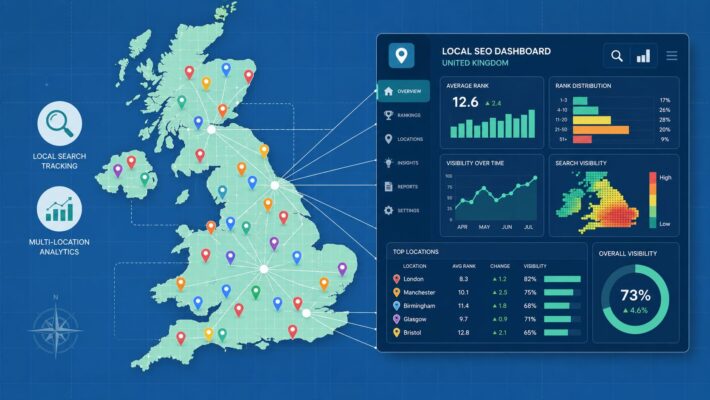
In practice, that’s where LocalHQ fits. Its AI Optimisation Wizard analyses profile data and competitor benchmarks to suggest category, keyword and content improvements. Its Review Autoresponder helps teams reply to customer feedback in real time while keeping replies aligned with the brand. The geo-grid rank tracker shows where visibility is strong or weak across a target area, which is much more useful than staring at one ranking position.
That doesn’t replace judgement. It supports it. You still need to know what matters to your customers and which services drive profit. But the repetitive work of spotting inconsistencies, maintaining activity and monitoring local movement becomes easier to manage.
A practical monthly rhythm
Businesses that stay visible usually follow a disciplined operating rhythm rather than occasional bursts of effort.
Try this monthly cadence:
- Week one: Audit profile accuracy, categories, services and hours.
- Week two: Review new customer feedback and respond properly.
- Week three: Improve one high-intent service or location page.
- Week four: Check map visibility by area and note where coverage is thin.
That routine is boring. It also works better than endlessly chasing hacks.
Measuring Local Success in an AI-Driven World
A lot of local SEO reporting still asks the wrong question. “What rank are we?” sounds sensible, but on its own it’s often misleading.
One ranking position doesn’t tell you how visible you are across a service area, whether customers trust what they see, or whether search visibility is turning into booked jobs, covers, appointments or store visits.
The metrics worth paying attention to
For local businesses, the strongest measures are usually action-based. Did people call from the profile? Did they request directions? Did they click through to a high-intent page? Did engagement improve in the areas that matter commercially?
Those signals don’t just tell you whether you’re visible. They tell you whether the visibility is useful.
- Direction requests: Strong for location-dependent businesses such as restaurants, clinics and shops.
- Calls: Helpful for urgent or service-led businesses.
- Website visits from profile interactions: Useful when the buying process needs more research.
- Geographic visibility trends: Important if you serve multiple postcodes or neighbourhoods.
Why rank tracking still matters, but differently
Rank tracking hasn’t become irrelevant. It just needs context. A single average rank can hide weak spots. You might appear well in one district and disappear a few streets away.
That’s why grid-based tracking is more useful than a vanity snapshot. It shows where the business is winning or losing local presence. For anyone serious about this, a local rank tracker for map visibility is far more informative than checking one keyword in one browser.
The right question isn’t “Are we number one?” It’s “Are we visible where profitable customers are searching, and are they taking action?”
Report like an operator, not a hobbyist
Business owners don’t need decorative charts. They need reporting that supports decisions. If calls are rising but direction requests are falling, that means something. If one location attracts strong review engagement and another doesn’t, that means something too.
The best reporting turns local SEO from a ranking obsession into an operating discipline. That’s when optimisation becomes commercially useful.
Get Your Business Ready For Tomorrow's Search
Search will keep changing, but the direction is already obvious. AI systems are pushing local discovery towards better interpretation, stricter trust evaluation and more answer-led experiences.
That sounds technical, yet the response is straightforward. Keep your business data accurate. Choose the right categories. Build a review profile that reflects real customer experience. Publish pages that answer real local questions. Track visibility where customers search.
The businesses that do those things consistently are easier for Google to understand and easier for customers to trust.
Local search AI ranking factors aren’t a separate game from local SEO. They’re the next version of it. The businesses that adapt early won’t just protect rankings. They’ll become easier to recommend across the search experiences that are taking shape now.
Get Your AI Optimisation Score
If your profile, reviews and local pages have been managed in bits and pieces, guessing what to fix first usually wastes time. A structured score is more useful than a hunch.
Use an AI-led audit to identify where your local presence is weak, which signals are inconsistent, and which changes are most likely to improve visibility. That gives you a practical starting point instead of another generic checklist.
If you want a clearer view of how your business is positioned for AI-driven local search, start with LocalHQ. It gives you a practical way to review profile quality, spot optimisation gaps, manage reviews, and track local visibility without relying on guesswork.