Responding to Negative Reviews Turn Critics into Advocates
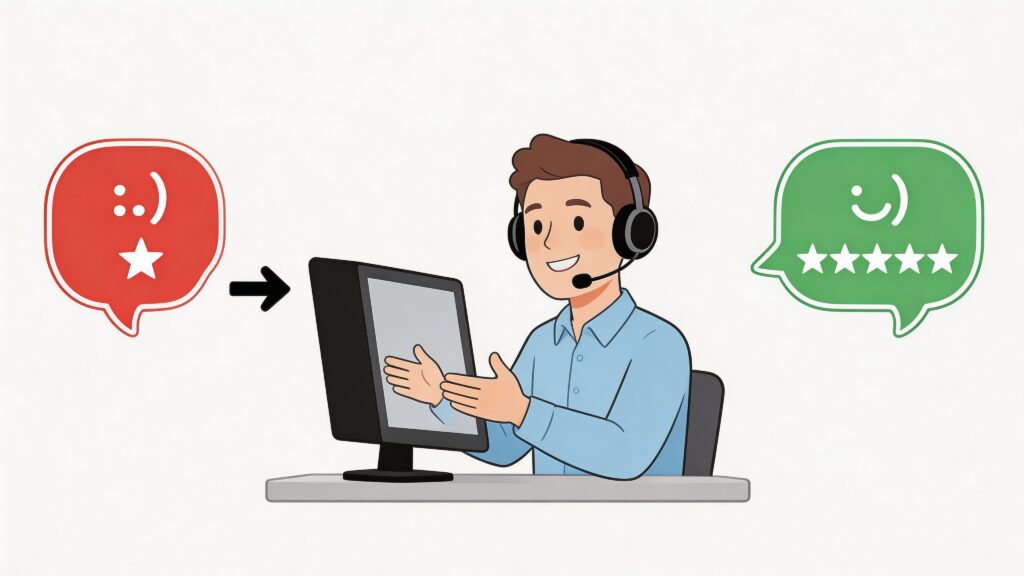
A harsh review often lands before the team’s first coffee.
A guest leaves a one-star Google review at 11.40 pm, describing slow service, a cold meal and a dismissive response at the till. By 8.00 am, the duty manager has seen it, the site manager is asking what happened, and the regional team wants to know whether this is a one-off or the start of a pattern. That’s a familiar morning in hospitality.
The hard part isn’t just the sting of public criticism. It’s what happens if nobody answers it well. In the UK, 86% of customers hesitate to purchase from businesses with negative reviews, with a single negative review driving away 22% of potential customers and three negative reviews deterring up to 59% according to UK-focused consumer behaviour studies published by Sanguine SA.
That’s why responding to negative reviews can’t sit in the “when we get time” pile. In a multi-location business, every unanswered complaint does two jobs at once. It puts off the next customer, and it signals internal slippage. If the same complaint appears across sites, you’re not looking at bad luck. You’re looking at an operating issue.
Handled properly, though, negative feedback is useful. It shows where service breaks, where handovers fail, where policies confuse guests and where managers need better support. A good response doesn’t just calm one upset reviewer. It tells future readers that the business is paying attention, takes responsibility and knows how to recover when things go wrong.
Introduction
The busiest sites usually attract the most scrutiny. That’s not a problem in itself. Strong businesses get criticised too.
Silence is the risk. When a guest says they were ignored, overcharged, kept waiting or spoken to badly, other people read that review as a preview of their own experience. They aren’t only judging the complaint. They’re judging the reply, or the absence of one.
In hospitality, speed matters because emotions run hot. A bad meal, a missed booking, a delayed room or a poor interaction with staff feels personal. If the business waits too long, the reviewer settles into their version of events and everyone else sees a dead thread.
I’ve found the most effective teams treat review handling like service recovery, not marketing copy. The work starts with basic discipline. Spot the review quickly. Classify it correctly. Answer in a way that matches the complaint. Escalate anything risky. Then log what happened so operations can fix the root cause.
Negative reviews are public incident reports. Read them that way, and the response gets sharper.
That doesn’t mean every complaint is fair. Some are exaggerated. Some are missing context. A few are malicious. Even then, the public reply still needs control. Defensive wording rarely wins. Clear, calm wording does.
The process below is the one that works across busy hospitality groups, local service brands and franchise networks. It balances empathy with pace, consistency with judgement, and customer care with the legal realities of replying in public.
Monitoring and triaging negative reviews
If your team only checks reviews when someone remembers, you’ll miss the ones that matter most.
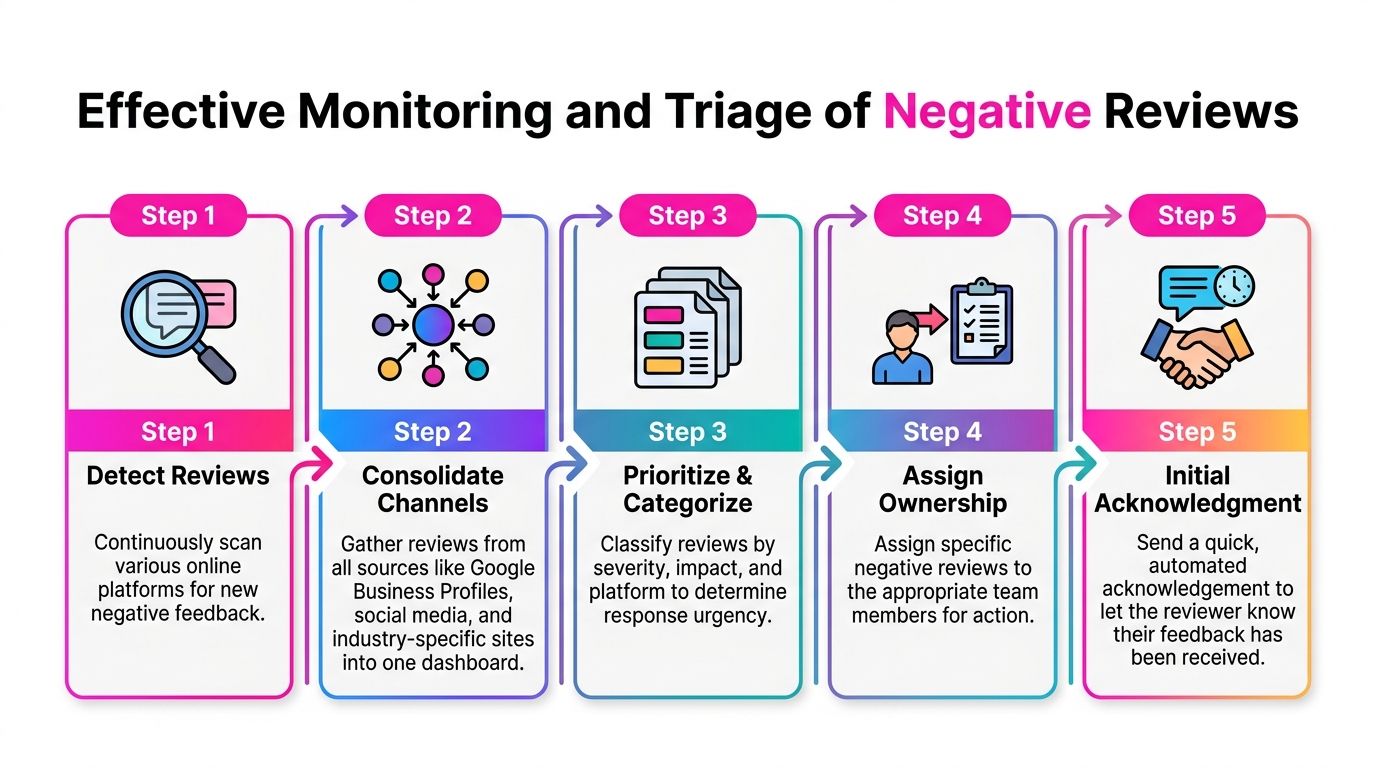
A working process starts with one rule. Every review must land in one place before it lands on someone’s desk. That sounds obvious, but many multi-location businesses still split this work between branch inboxes, personal logins and ad hoc screenshots in group chats.
Build one monitoring queue
For most hospitality and service teams, the priority list is straightforward:
- Google first because it affects discovery, trust and day-to-day decision-making for local customers.
- Core review platforms next based on your category, such as restaurant, travel or local service directories.
- Social comments after that because complaints often start there before they appear in formal review channels.
If your branch managers still log in to platforms separately, fix that first. A central dashboard gives the operations team a single queue and stops reviews being missed during leave, shift changes or weekend gaps. If you need a practical overview of how a listing works before tightening your process, Postful’s guide to Google Business Profile for Small Businesses is a useful starting point.
The monitoring setup should answer four questions immediately:
- Which location was reviewed?
- Which platform published it?
- What is the complaint about?
- Who owns the reply?
For businesses that need central visibility across branches, a shared monitoring layer such as online reputation monitoring helps route new reviews into one workflow instead of relying on local staff to remember manual checks.
Triage by risk, not just star rating
A one-star review is not always your highest-risk item. A two-star review describing a food safety concern, discriminatory behaviour or a payment issue can be far more serious than a vague one-star rant with no detail.
That’s why triage needs categories.
Use a simple internal model:
Urgent and high-risk
Reviews alleging safety issues, discrimination, fraud, privacy concerns, threats, or media-sensitive incidents. These need senior review before any public response.Operational failures
Complaints about booking errors, no-shows, incorrect opening times, missing orders, billing mistakes or broken promises. These often need fact-checking with systems and shift logs.Service interaction issues
Complaints about rudeness, indifference, poor attitude or lack of ownership. These need a more careful tone because the customer’s frustration is usually about how they were treated, not only what went wrong.Low-detail dissatisfaction
Brief negative reviews with little explanation. These still deserve a response, but the first goal is acknowledgement and an invitation to continue privately.
Set time standards that match customer expectations
The target should be tighter than commonly assumed.
Consumer expectations are clear. 89% expect responses within 48 hours, and consumers are 33% more likely to upgrade negative reviews if businesses respond within 24 hours, according to OpenSend’s review response statistics.
That means your process should work backwards from the first 24 hours, not from “sometime this week”.
A practical timing model looks like this:
| Action | Internal target | Why it matters |
|---|---|---|
| Review detected | As soon as it appears | Stops overnight or weekend drift |
| Severity assigned | Early in the queue | Prevents low-risk items blocking urgent ones |
| Owner assigned | Same working block | Removes ambiguity |
| Initial acknowledgement | Within the first response window | Shows the guest has been heard |
| Full reply or escalation | After fact check | Keeps the reply accurate |
Practical rule: fast acknowledgement is useful, but a fast inaccurate reply creates more work than a short delay used to verify facts.
Give each review an owner
Shared responsibility usually means nobody responds well. Every review needs one named owner, even if others contribute.
In a multi-site operation, the cleanest split is usually:
- Site manager for routine service recovery.
- Regional or head office support for recurring issues and reputational risk.
- Legal or senior leadership for disputed facts, allegations, regulated sectors or public threats.
That ownership model matters because the first response often sets the tone for everything that follows. If junior staff improvise on sensitive complaints, you get inconsistency across locations. If head office controls every reply, you get bottlenecks and robotic copy.
The right balance is central rules with local context.
Crafting tone and templates for responses
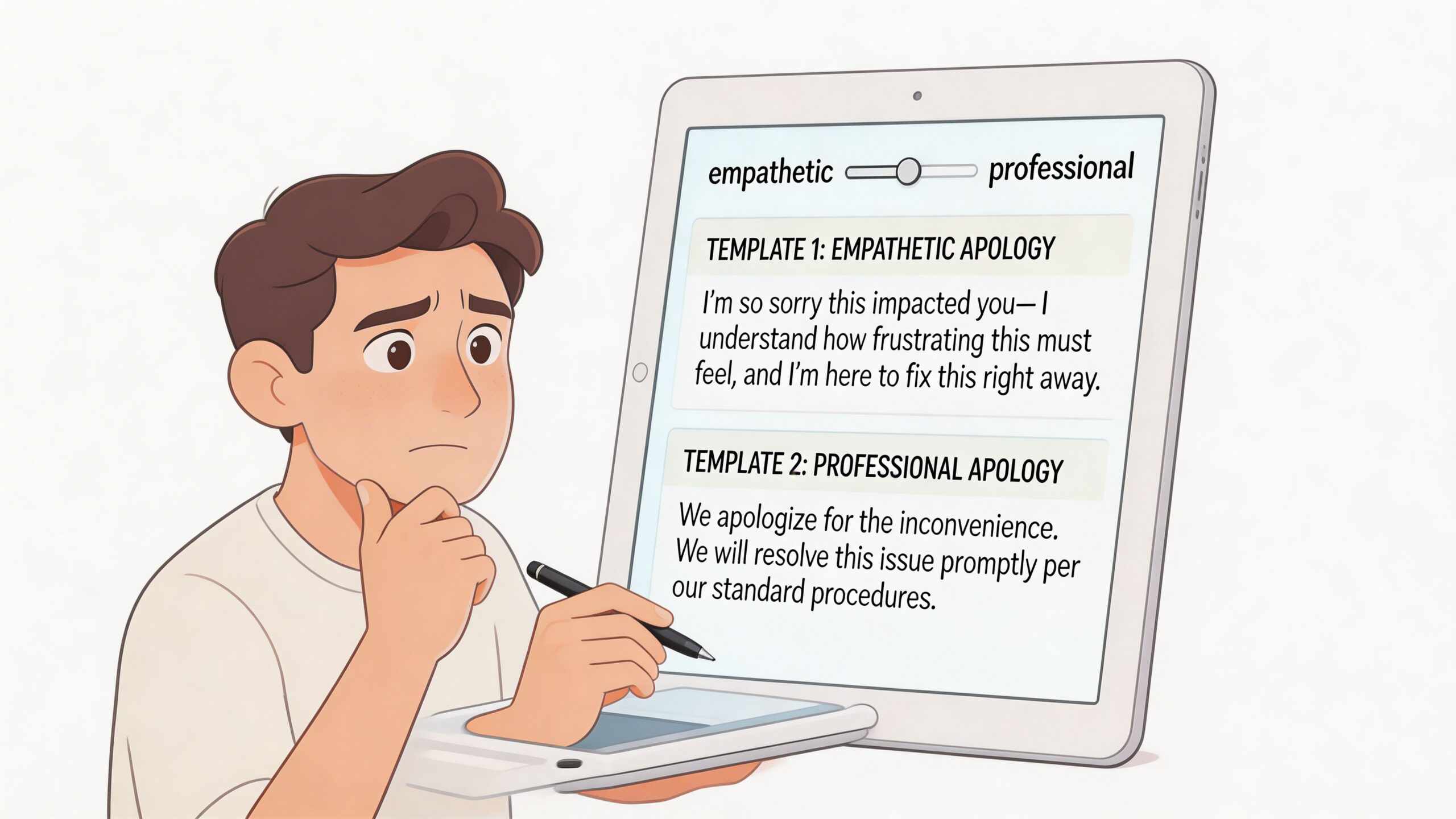
Most weak replies fail in one of two ways. They’re either too cold, or too emotional.
Cold replies read like policy notes pasted into a public thread. Over-emotional replies sound vague, over-apologetic and sometimes evasive. Good responses sit in the middle. They acknowledge the experience, state what will happen next, and avoid making promises the branch can’t keep.
Match the tone to the complaint type
Teams improve quickly once they stop using one generic template for everything.
Research published by Information Systems Research found that effective responses must match complaint type: rational cues work for procedural complaints, emotional cues are vital for interactional unfairness cases, and a balanced approach is best for refund disputes.
In practical terms:
- If the complaint is about a process failure, use a structured reply. Mention the issue, confirm the correction path, and explain the next step.
- If the complaint is about staff attitude or disrespect, lead with empathy. Customers in those cases want to feel heard before they hear procedure.
- If the complaint is about money, refunds or charges, combine empathy with clear process language. Too much softness sounds slippery. Too much procedure sounds dismissive.
That distinction matters more than clever wording.
What a strong public reply includes
A useful public response usually has five parts:
Recognition
Show that you’ve read the review, not just the rating.Ownership
Accept responsibility for investigating or correcting the issue, even when the facts still need checking.Appropriate tone
Rational for procedural faults, empathy-first for interpersonal failures.Next step
Offer a route to continue privately when details are needed.Operational signal
State, carefully, that the issue is being reviewed internally where that’s true.
The wording should stay short. Public replies are not the place for a full incident report.
Templates that work in practice
A template should save time, not remove judgement. These are starting points, not scripts to paste without editing.
Procedural complaint template
Use this for booking errors, delayed orders, incorrect opening times, missed reservations or policy confusion.
Hello [Name], thank you for flagging this. We’re sorry your booking experience fell short. What you’ve described isn’t the standard we aim to deliver. We’re reviewing what happened at the site and would like to look into the details properly. Please contact us at [channel] with your booking information so we can resolve this directly.
Why it works: it’s calm, specific and procedural. It doesn’t overplay emotion. It promises review, not instant certainty.
Interactional complaint template
Use this when the guest felt dismissed, embarrassed or spoken to badly.
Hello [Name], I’m sorry to read about the way you were made to feel during your visit. That’s not acceptable, and I understand why you’re upset. We take comments about staff conduct seriously and will review this with the team. If you’re willing, please contact us at [channel] so we can follow up properly.
Why it works: the first sentence validates the person, not just the event.
Refund or charge dispute template
Use this for billing errors, disputed charges or unresolved refund concerns.
Hello [Name], thank you for raising this. I’m sorry for the frustration caused by the charge and the time it’s taken to get clarity. We’d like to review the transaction and the related communication so we can give you an accurate response. Please contact us at [channel] with the relevant details, and we’ll investigate this as a priority.
Why it works: it balances empathy with process and avoids making a public financial commitment before checking records.
What not to write
Some phrases create trouble immediately:
“This didn’t happen.”
Never write this publicly unless the facts are indisputable and approved internally.“That’s our policy.”
Customers hear this as a brush-off unless it’s framed with care.“Please remove your review.”
This looks controlling and often escalates the exchange.“We apologise if you felt…”
That wording sounds evasive because it questions the customer’s experience.
If your team needs a tighter framework specifically for Google, this guide on how do you respond to a Google review is useful for shaping replies that are short, public-facing and still human.
A good review response protects the brand twice. It helps the reviewer in front of you, and it reassures the next customer who’s reading silently.
Escalation workflows and legal considerations
Not every review should stay with the branch.
In hospitality groups, the biggest mistakes usually happen when frontline teams try to handle serious allegations as if they were ordinary service complaints. The instinct is understandable. They want to fix the problem quickly. But some issues need a different lane from the start.
Use an escalation ladder
A simple escalation ladder keeps decision-making tidy.
Level one
Routine complaints go to the site manager or customer service lead. These include delayed service, poor food quality, order mistakes and low-detail dissatisfaction. The response can usually stay public, then move private for follow-up.
Level two
Pattern complaints go to regional operations. If multiple locations receive the same criticism, this isn’t a single-site problem. It may involve training, supplier issues, staffing pressure or broken process design.
Level three
Sensitive complaints move to senior leadership, HR or legal support. That includes allegations about discrimination, harassment, health and safety, false advertising, medical issues, refunds in regulated settings, or anything likely to trigger media attention.
The public reply at this level should be brief and controlled. Don’t crowd it with explanation.
Know when to take the conversation offline
Taking a review offline is not the same as hiding it. It’s the right move when the resolution needs personal data, transaction records or a more nuanced discussion than a public thread allows.
Move it offline when:
- The guest must share private details such as booking references or payment information.
- The facts are disputed and internal records must be checked.
- The complaint is emotional and prolonged and a direct conversation is more likely to de-escalate it.
- The remedy needs managerial discretion such as a goodwill gesture or exception.
What doesn’t work is replying with a generic “email us” and stopping there. The public response still needs accountability. The reviewer and future readers need to see that the business took ownership before shifting channels.
Stay accurate under UK rules
Public responses are not free-form. They’re part customer service, part public statement.
Under the UK Consumer Rights Act 2015, businesses must respond truthfully and not mislead. False claims can lead to CMA enforcement, and 15% of ASA complaints involve misleading business replies, according to the UK-specific guidance cited by Yotpo.
That means three practical rules matter:
- Don’t deny facts you haven’t checked.
- Don’t invent context to make the business look better.
- Don’t overstate what was offered or agreed offline.
This is especially important when the review is unfair, incomplete or plainly hostile. The urge to “set the record straight” can push managers into risky wording. Stick to what you can verify.
Keep records like you may need them later
Every escalated review should have a simple internal record:
| Item | What to log |
|---|---|
| Review copy | Screenshot or export of the original text |
| Location details | Site, date, service period, staff involved |
| Public reply | Final wording and approval path |
| Private follow-up | Email, call notes, offers made |
| Outcome | Resolved, disputed, no response, further action needed |
If the complaint turns into a formal dispute, PR issue or platform challenge, that file becomes essential. It also helps when a manager asks to remove negative reviews on Google and needs to separate policy breaches from genuine criticism that should be answered, not challenged.
Calm wording and clean records beat an argumentative reply every time.
Tracking outcomes and KPIs
Once the process is running, the next challenge is proving whether it’s working.
Too many teams stop at “we’re responding more consistently now”. That’s progress, but it isn’t management information. If you run several locations, you need to know whether response speed is improving, whether problem categories are changing, and whether review handling is affecting local visibility and customer actions.
Track behaviour before reputation
The most useful review KPIs start with process, not vanity.
If the process is sloppy, the star rating discussion becomes noise. Measure the team’s behaviour first.
Here’s a practical KPI table to use.
| KPI | Benchmark | Impact |
|---|---|---|
| Negative review response coverage | Aim for consistent coverage across locations | Shows whether complaints are being left unanswered |
| Response time | Prioritise replies inside the first day where possible | Helps protect trust and supports review recovery |
| Escalation rate | Track which complaints require senior handling | Reveals legal, PR or operational pressure points |
| Complaint category trend | Monitor repeat themes by site | Helps operations fix root causes |
| Review revision or follow-up rate | Track whether customers re-engage after contact | Indicates whether recovery efforts are landing |
| Maps visibility on locations with strong response discipline | Compare locations over time | Helps connect reputation work to discovery outcomes |
| Direction requests and calls from listings | Review alongside response coverage | Shows whether reputation management is supporting action |
The key is consistency. Use the same labels for the same issues across every branch.
Tie review handling to local search performance
Many agencies and franchise teams still undershoot in this area. They answer reviews, but they don’t connect that work to visibility.
UK multi-location franchises responding to 80%+ of negative reviews within 24 hours saw 19% higher Maps visibility and 14% more direction requests, yet only 23% track this via geo-rank tools, according to Ever-Help’s review response analysis.
That matters because responding to negative reviews is not only a customer service activity. It’s also part of local search operations.
For each location, compare:
- Review response coverage against local rankings for priority terms
- Average reply time against listing actions such as calls or directions
- Complaint themes against operational dips in specific branches
If one site responds quickly but still draws repeated complaints about wait times, the issue is probably staffing or process. If another site has decent service but poor visibility, the problem may sit with listing quality, categories or local competition.
Build a dashboard managers will actually use
The best KPI dashboard is short enough to scan in one meeting.
Use one view for branch managers and one for regional leadership.
Branch view
Focus on open negative reviews, ageing items, top complaint themes and follow-up status.
Regional view
Focus on cross-location comparison, repeat failure patterns, response discipline and visibility trends.
A reporting setup linked to Google Business Profile insights makes that easier because it keeps customer actions, listing performance and review patterns in the same operational conversation.
If a KPI doesn’t change someone’s next action, it belongs in an archive, not on the weekly dashboard.
Automating and scaling responses with LocalHQ
At some point, manual review handling breaks down.
That usually happens when a business adds more locations, stretches opening hours, or relies on branch managers to handle reviews around everything else they’re already doing. The result is predictable. Replies become late, inconsistent or rushed.
Automation helps, but only if it supports judgement instead of replacing it.
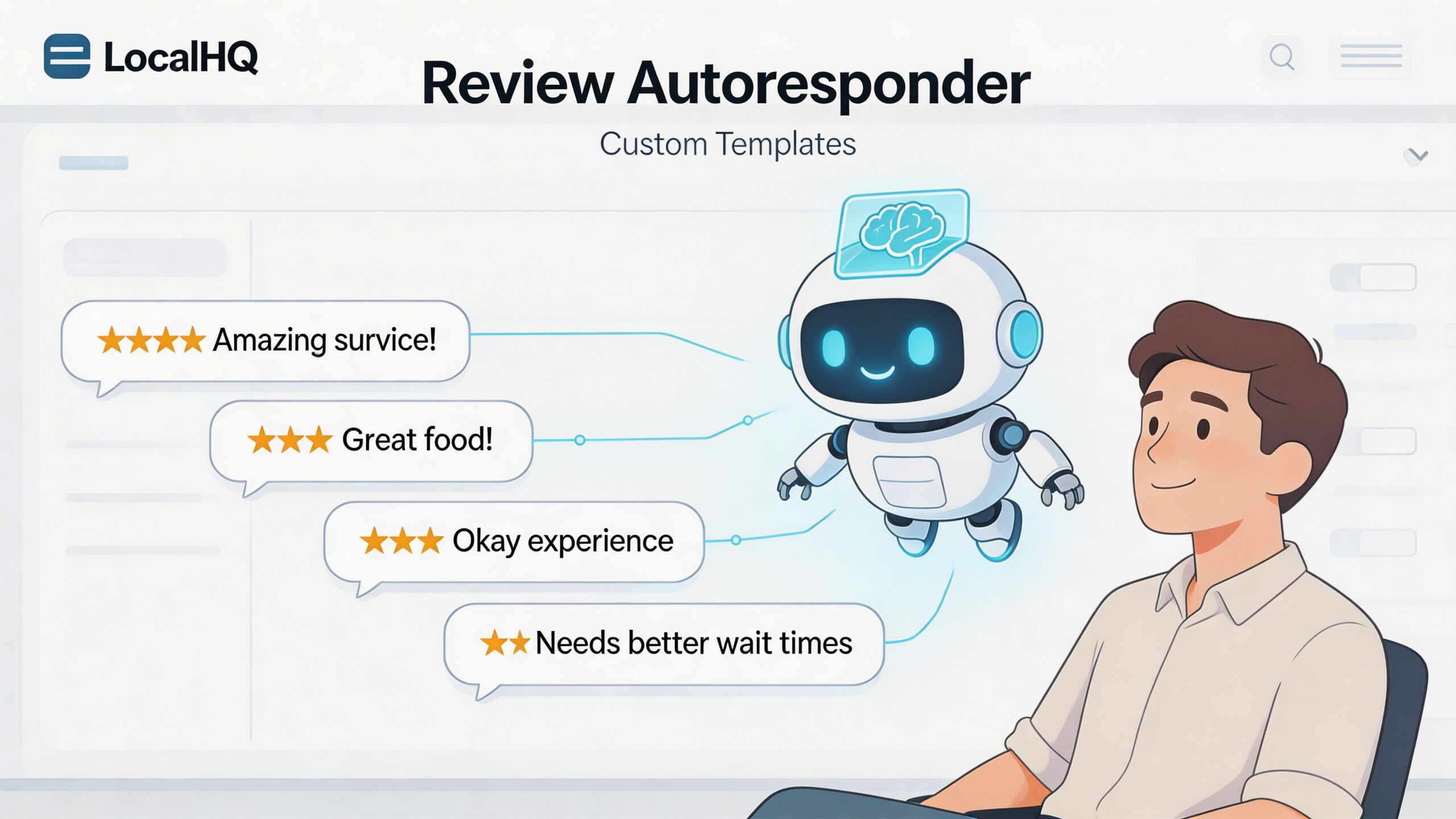
What should be automated
Some parts of responding to negative reviews are repetitive and safe to systemise.
These usually include:
- Instant acknowledgement so the customer sees the business has received the complaint
- Template selection based on complaint type
- Routing rules that send high-risk reviews to the right manager
- Queue ordering so the oldest and most serious issues surface first
- Draft generation that gives staff a structured starting point
Review tools and broader customer service automation software can fit into the w…ai/customer-service-automation-software/) can fit into the workflow sensibly. The value isn’t in sounding robotic faster. It’s in removing admin so staff can spend time on the reviews that need human judgement.
What should stay manual
Not every negative review deserves full automation.
Keep a person in the loop when the review involves disputed facts, legal risk, refund complexity, safeguarding concerns, regulated services, or allegations about employee conduct. Those situations need context, record checks and wording discipline.
The strongest setup is hybrid:
| Review type | Best handling model |
|---|---|
| Low-detail dissatisfaction | Automated acknowledgement plus edited draft |
| Routine operational complaint | Drafted response with manager approval |
| Complaint about staff attitude | Empathy-led draft with human rewrite |
| Refund or billing dispute | Manual review before public reply |
| Safety, discrimination or legal risk | Escalation only, no automated posting |
That model keeps pace without flattening every response into the same tone.
How LocalHQ fits into the workflow
For teams already managing Google review volume at scale, LocalHQ can be used to centralise the queue, generate on-brand draft replies and route items by sentiment and urgency through its Google Review Autoresponder. In practice, that means a branch doesn’t need to write from scratch every time, while head office still keeps control over escalation rules and wording standards.
That kind of setup works best when the team has already agreed on three things:
- Approved response frameworks for common complaint types
- Escalation triggers for anything sensitive
- Personalisation fields such as location name, issue type and service context
Without those controls, automation scales inconsistency.
The trade-off most teams get wrong
Some teams fear automation because they think it removes warmth. Others lean on it too heavily and publish replies that sound stitched together.
Both problems come from the same mistake. They treat automation as the strategy instead of the delivery layer.
The strategy is still human. Classify the complaint correctly. Use the right tone. Be accurate. Know when to move offline. Feed patterns back into operations.
Automation just helps the team do that reliably at volume.
The standard isn’t “was this written by AI or a manager?” The standard is “did this response feel accurate, timely and appropriate to the complaint?”
If the answer is yes, the system is doing its job.
Conclusion and next steps
Responding to negative reviews well is less about clever wording and more about control.
The businesses that handle this best don’t improvise. They monitor every platform that matters, triage reviews by risk, use complaint-specific response frameworks, escalate sensitive issues early and measure what happens afterwards. That’s what turns review management from a reactive chore into an operational discipline.
For hospitality teams, that discipline protects more than reputation. It protects bookings, walk-ins, repeat visits and local visibility. It also gives managers a cleaner view of what’s going wrong on the floor, at the desk or in the handover between systems and people.
If you’re tightening the process now, keep the checklist simple:
- centralise review monitoring
- set ownership by location and severity
- build templates for different complaint types
- move the right cases offline
- log outcomes and recurring causes
- use automation where speed helps, not where judgement is needed
That approach keeps replies human without making them slow, and it keeps operations accountable without turning every review into a long public exchange.
The final test is straightforward. When a potential customer reads a bad review about your business, does your response make them trust you more or less?
That answer is what your process is really producing.
If you want to put this into practice across one site or many, LocalHQ gives you a practical way to monitor reviews, organise response workflows and keep replies consistent without losing local context. Explore LocalHQ to see how its review tools can support a faster, more controlled response process.